If moisture is the enemy of the industrial air compressor, its hero is the compressed air dryer system-a critical device designed to remove water vapor from compressed air and maximize the efficiency of your equipment. At Brabazon, we understand how vital these systems are to your business's operation, so we recommend and carry a wide selection of compressed air dryers.
In this article
Why Moisture in Compressed Air is a Problem
Air compressors work by pulling in ambient air and anything that’s in it, including water vapor. As the air is compressed, its temperature increases, and the water vapor molecules are forced closer together. Then the compressed air usually passes through a cooler, dropping its temperature below its dew point. At this point, the air can no longer hold its water vapor, and it turns into liquid within the system. Moisture inside air compressors can lead to several issues:
- Corrosion - Water can cause rust on metal parts of the compressor and tools that use compressed air. This can lead to damage and premature failure of equipment.
- Frozen Pipes - In colder environments, moisture in compressed air lines can freeze, blocking the lines and potentially causing damage.
- Degradation of Products-Moisture can contaminate products in industries such as paints, pharmaceuticals, or food processing, affecting quality and safety.
- Operational Inefficiency - Moisture can affect the proper functioning of pneumatic systems, leading to inefficiencies and increased maintenance costs.
Types of Compressed Air Dryer Systems
Several compressed air dryers are suited to different environmental conditions and industry needs. The most common types include refrigerated and regenerative - or desiccant - dryers. Refrigerated dryers cool air to remove moisture and are well-suited for general plant air. In contrast, regenerative dryers use materials that physically adsorb water vapor and are necessary for more sensitive applications requiring extremely dry air, such as pharmaceuticals or food processing.
How Regenerative Air Dryers Work
In regenerative air dryers, compressed air passes through a chamber containing the desiccant - a hygroscopic substance that absorbs moisture from the air - and it wicks the water vapor from the air, making it dry. Once the desiccant is fully saturated, it must be dried or regenerated. This is done using one of two main methods:
- Heatless Dryers - In heatless regenerative dryers, like the Pure-Air H-Series, a portion of the dried compressed air is diverted back through the saturated desiccant to purge it of moisture. This method does not use external heat and relies on the pressure difference to desorb moisture.
- Heated Dryers - Heated regenerative dryers use an external heat source to warm the desiccant, which helps to drive off the adsorbed moisture more efficiently. This method can be further divided into externally heated and blower purge designs, where either direct heat is applied or hot air is blown through the desiccant.
How Refrigerated Air Dryers Work
Refrigerated air dryers operate like a household refrigerator or air conditioning system. All involve cooling the air to a low temperature to condense the moisture, which is then collected in a separator and drained away. There are two main types of refrigerated air dryers:
- Non-Cycling Refrigerated Air Dryers-The refrigeration system in a non-cycling dryer, like the Sullair RN Non-Cycling unit, runs continuously, regardless of the actual load or demand for dry air. This means the dryer's compressor is always on while the dryer is operational.
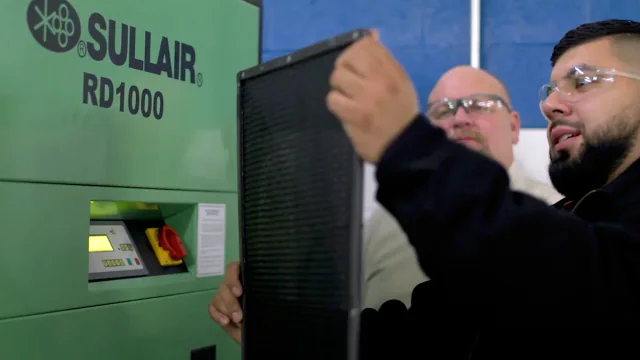
- Cycling Refrigerated Air Dryers - The refrigeration compressor in a cycling system, like the Sullair RD Cycling unit, can turn on and off based on the air demand. It includes a thermal storage medium - usually a cold mass or phase change material - that helps maintain the necessary cooling to dry the air even when the compressor is off.
Choosing between a cycling and a non-cycling refrigerated air dryer often depends on specific operational needs. For operations that require a consistent and continuous supply of dry air, non-cycling dryers may be preferable due to their constant performance. Cycling dryers may offer better energy efficiency and cost savings for facilities where air demand varies significantly, such as those with shifts or varying production schedules.
Contact Us
Explore Air Solutions with Brabazon
Choosing the right compressed air dryer system can be challenging without the correct information and guidance. At Brabazon, we not only provide advanced technology and reliable products but also offer personalized consultations to help you select the perfect system for your needs. Contact Brabazon today to discuss how our compressed air dryer systems and air-cooled air compressors can enhance your operational efficiency.
Written by
Heath Brabazon
President