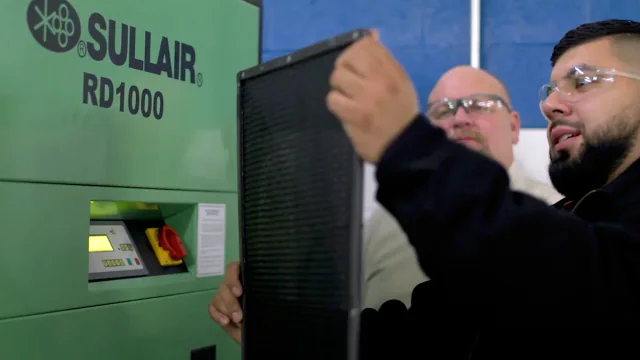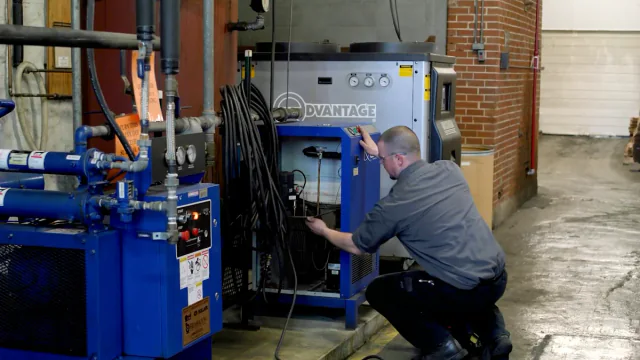

Compressed air dryers hold the key to maintaining compressed air quality by diligently removing moisture. Their pivotal role cannot be understated, as moisture-laden compressed air can cause corrosion, damage equipment, and jeopardize product quality, a problem you are likely familiar with fighting if you are operating in the humid Midwest. Whether you're an operations manager overseeing a sprawling industrial plant or a technician maintaining a compact workshop, there's a compressed air dryer perfectly sized to meet your requirements.
In this article
Zooming In: Determining the Ideal Size for a Compressed Air Dryer
Just as one wouldn't buy shoes without considering the size, selecting a compressed air dryer requires attention to its sizing. Making an informed choice involves understanding your specific requirements and aligning them with the capabilities of the dryer. Be sure to consider the following for an ideal fit:
Facility Size:
The physical footprint of your operation is an immediate indicator. Larger facilities often have extended air pipelines, requiring a more powerful dryer to maintain consistent air quality throughout. Moreover, bigger spaces might house more machinery, increasing the overall demand for a compressed air dryer.Frequency of Use:
Accurate size selection is not just about the size but also the operational rhythm of your facility. A facility running 24/7 requires a dryer built for endurance, ensuring that moisture is consistently kept at bay without downtimes. On the other hand, intermittent operations might get by with a model designed for less rigorous use.Existing Environmental Conditions:
The inherent humidity of a location plays a significant role in your choice. An operation in a tropical, humid region will naturally face greater moisture challenges than one in a drier climate. Therefore, the dryer's efficiency and power must compensate for existing environmental moisture levels.
In essence, selecting the appropriate size of a compressed air dryer is a combination of understanding both your operational needs and the external influencing factors.
Correct Size and Beyond
While the correct size of a compressed air dryer is an integral piece of the puzzle, it's also crucial to consider other elements like energy consumption, maintenance needs, and future scalability. Talking with a reliable expert like Brabazon can simplify this process, so your compressed air dryer is optimally sized and holistically integrated into your operational landscape.
A Spectrum of Sizes to Suit Every Need
We carry a wide range of compressed air dryers, each designed for a variety of needs. From compact units ideal for smaller operations to larger, industrial-grade models designed for expansive facilities, Brabazon offers an array of choices to make sure that every demand is met with precision.
The Criticality of Precise Sizing in Various Industries
Each industrial sector has unique requirements when it comes to compressed air and compressed air dryers. For instance:
Pharmaceuticals:
In an industry where precision is paramount, even a trace of moisture can disrupt the efficacy of medicines. Pharmaceuticals often involve intricate processes, from tablet compression to vial filling, where dry air is essential to prevent product contamination. An accurately sized dryer sees that the compressed air remains consistently devoid of moisture, safeguarding the high-quality standards the industry demands.Automotive Manufacturing:
Producing a vehicle involves several stages sensitive to moisture, especially painting and finishing. A car's paint job requires a moisture-free environment to prevent defects like blistering or peeling. Manufacturers can create a flawless finish with the right-sized compressed air dryer, maintaining the vehicle's aesthetic appeal and longevity.Food and Beverage:
This sector thrives on safety and freshness. Compressed air often comes into contact with food products directly or indirectly. A moisture-laden environment can lead to contamination risks. Companies can uphold the highest food safety standards by using an adequately sized compressed air dryer, building consumer trust and regulatory compliance.
In all these sectors and many others, the importance of an accurately sized compressed air dryer cannot be stressed enough. It directly impacts both the final product and the efficiency of the manufacturing process.
Correction Factors: The Most Overlooked Part of Dryer Sizing
Every compressed air dryer is rated at standard conditions: typically 100°F inlet temperature, 100 PSI inlet pressure, and 100°F ambient temperature. The problem? Your facility almost certainly operates at different conditions. If you size a dryer based solely on the rated CFM and your actual conditions differ, you may end up with a dryer that can't maintain the dew point you need.
Here are the three most important correction factors Brabazon's engineers apply when sizing dryers for Midwest industrial facilities:
Inlet Air Temperature Correction: If your compressor runs hot (130°F inlet to the dryer is common without an aftercooler upgrade), the dryer's effective capacity can drop by 30 to 40%. Adding or servicing an aftercooler to bring inlet temperature down to 100°F is often a better investment than buying an oversized dryer.
Operating Pressure Correction: Higher operating pressure improves dryer efficiency (the correction factor is greater than 1.0 above 100 PSI). If your system runs at 125 PSI, your dryer's effective capacity increases slightly - a useful factor to know when evaluating whether your existing dryer is still adequate after a system expansion.
Ambient Temperature Correction: In summer months in Illinois, Wisconsin, or Missouri, ambient temperatures in non-air-conditioned compressor rooms can reach 110 to 120°F. At these temperatures, refrigerated dryer efficiency drops significantly. Brabazon accounts for the worst-case summer conditions when sizing dryers to ensure year-round performance.
Dryer Sizing Example: 75 HP Sullair Compressor in Chicago
A 75 HP Sullair rotary screw compressor produces approximately 300 CFM at 125 PSI. But with a 120°F compressor room in summer, a 125°F inlet air temperature, and 125 PSI operating pressure, the required dryer capacity after correction factors is approximately 380 to 400 CFM - 25 to 30% more than the compressor's nameplate CFM. Brabazon routinely performs this analysis for every dryer specification we provide to customers in the Midwest.
Perfectly Sized Compressed Air Dryers from Brabazon
Dryer Sizing FAQ
My old dryer worked fine for 10 years. Can I just replace it with the same size?
Not necessarily. If your compressed air usage has increased, your compressor has been upgraded, or you've added production equipment, your current demand may exceed what the original dryer was designed for. Brabazon recommends a quick demand assessment before any dryer replacement to ensure the new unit is properly sized for today's requirements.
Is it better to oversize or undersize a compressed air dryer?
Oversizing is generally preferred over undersizing. An oversized refrigerated dryer will cycle more efficiently, run cooler, and last longer. An undersized dryer will struggle to maintain dew point during peak demand and fail prematurely. That said, significant oversizing wastes money. Brabazon targets 15 to 20% oversizing as the sweet spot for most applications.
Can I use the same dryer if I add a second compressor?
Only if the dryer's corrected capacity exceeds the combined maximum output of both compressors. Adding a second compressor without upgrading the dryer is a very common cause of moisture problems in Midwest industrial facilities. Brabazon assesses this during our air system audits.
Who does Brabazon serve for dryer sizing and installation?
We serve industrial and manufacturing facilities throughout Wisconsin, Illinois, Minnesota, Indiana, and Missouri - including Chicago, Milwaukee, Minneapolis, Green Bay, Rockford, St. Louis, Decatur, Marion, Duluth, Jefferson City, Wausau, Eau Claire, Madison, and Michigan City. Contact your nearest Brabazon location to get started.
Written by
Heath Brabazon
President