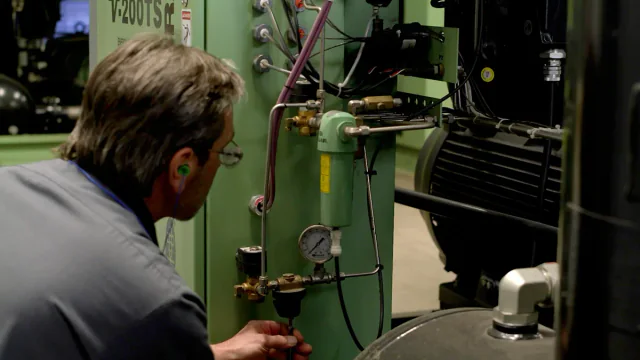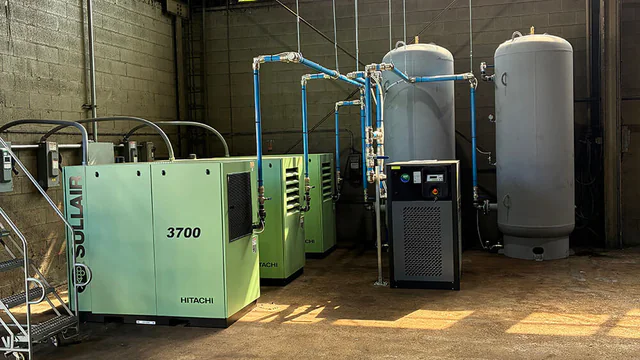
The average industrial air compressor represents a capital investment of $15,000 to $150,000 or more - and powers production equipment that may be worth far more than that. Yet many facilities treat air compressor maintenance as reactive: they wait for something to fail, then call for service. The result is unplanned downtime, emergency repair costs, shortened equipment life, and in many cases, complete compressor failure years before the unit should have needed replacement.
A structured preventive maintenance program changes that equation. Brabazon develops and executes PM programs for industrial air compressors, pumps, and vacuum systems throughout the Midwest - helping facilities in Wisconsin, Illinois, Minnesota, and Missouri keep their equipment running at peak performance year-round. This guide outlines the key maintenance tasks, recommended intervals, and warning signs that every facility manager and maintenance team should know.
In this article
Daily Checks: What Your Team Should Do Every Shift
Effective compressor maintenance starts with what your own operators and maintenance team do every day. These checks take minutes but catch the conditions that accelerate wear and lead to failures:
Check operating pressure and temperature:
Verify the compressor is maintaining proper operating pressure and that discharge temperatures are within normal range. Elevated temperatures often indicate blocked coolers, low oil, or failing cooling systems.Inspect for leaks:
Walk the lines and listen for audible air leaks. Check connections, drain valves, and fittings. Even small leaks increase compressor run time and energy consumption significantly.Verify automatic drains are working:
Condensate drains should be cycling properly. Failed drains allow liquid water to accumulate in your system, causing corrosion and contamination.Check oil level:
On oil-flooded compressors, verify oil level is within the sight glass range. Low oil leads to overheating and accelerated wear on internal components.Review fault codes and alerts:
Modern compressors log fault conditions. Review the controller display daily and address any active alerts before they become failures.
Monthly Maintenance Tasks
In addition to daily checks, certain maintenance tasks should be performed monthly - or more frequently in demanding environments like dusty facilities, high-humidity operations, or continuous-duty applications:
Clean or inspect the air/oil separator element:
A clogged separator causes oil carryover into the compressed air stream and increases differential pressure across the compressor, raising energy consumption.Inspect the inlet filter:
A restricted inlet filter reduces airflow to the compressor, causing it to work harder and run hotter. In dusty environments, filters may need replacement weekly, not monthly.Check belt tension and condition (belt-drive units):
Loose or cracked belts reduce compressor efficiency and can fail suddenly, causing unplanned downtime.Test safety relief valves:
Manually test safety relief valves to verify they operate and reseat properly. A stuck or weeping relief valve is both a safety hazard and a source of air loss.
Annual Service: What Should Be Done by a Factory-Trained Technician
Annual maintenance is where the heavy lifting happens - and where factory-trained technicians with brand-specific expertise make a significant difference. Brabazon's technicians hold factory certifications from Sullair, Atlas Copco, Ingersoll Rand, Kaishan, Quincy, and other leading manufacturers, meaning they know exactly what each unit requires at each service interval.
Annual service typically includes fluid analysis and oil change, replacement of the air/oil separator element, replacement of inlet filter elements, inspection and cleaning of coolers (both air-cooled and water-cooled), inspection of all belts, couplings, and drive components, calibration of the system controller and pressure settings, and a full system leak check with ultrasonic detection equipment.
Many facilities also use the annual service visit to perform a broader compressed air audit - measuring actual system demand, checking for pressure drop across distribution piping, and identifying opportunities to improve efficiency or address capacity constraints before they become operational problems.
Warning Signs That Your Compressor Needs Service Now
Even with a solid PM program in place, compressors can develop problems between scheduled service intervals. Knowing what to watch for allows your team to call for service before a developing problem becomes a full failure:
Rising operating temperature:
A compressor running hotter than normal is working harder than it should. Causes include blocked coolers, low oil, high ambient temperature, or a failing thermal valve.Increased cycling frequency:
If your compressor is loading and unloading more frequently than normal, you may have a demand increase, a worsening system leak, or a control issue.Oil in the compressed air:
Oil contamination downstream of the compressor indicates a failing air/oil separator element or excessive system pressure causing oil to bypass the separator.Unusual noise or vibration:
Bearing wear, loose internal components, and failing cooling fans all produce distinctive sounds. Don't ignore noise changes - investigate immediately.Rising energy consumption:
A compressor that's working harder than normal consumes more electricity. If your energy bills are climbing without a corresponding increase in production demand, your compressor may need service.
Schedule a PM Visit
Ready to Put Your Compressor on a Maintenance Program?
Brabazon's preventive maintenance programs are customized to your specific equipment, operating environment, and production schedule. We offer quarterly, semi-annual, and annual service agreements covering all major air compressor brands throughout Wisconsin, Illinois, Minnesota, and Missouri. Our service vans are stocked with OEM parts so most service work - including unplanned repairs discovered during PM visits - can be completed on the first visit.
Call 800.825.3222 or contact us online to discuss a maintenance program for your facility. Ask about our emergency service availability - a live Brabazon representative answers every call, 24 hours a day.
Written by
Heath Brabazon
President