Oil-free compressors
Class 0 air for contact packaging and nitrogen generator feed air.
Spec Class 0 air
Industry: Packaging
Packaging Utilities Spec Plate
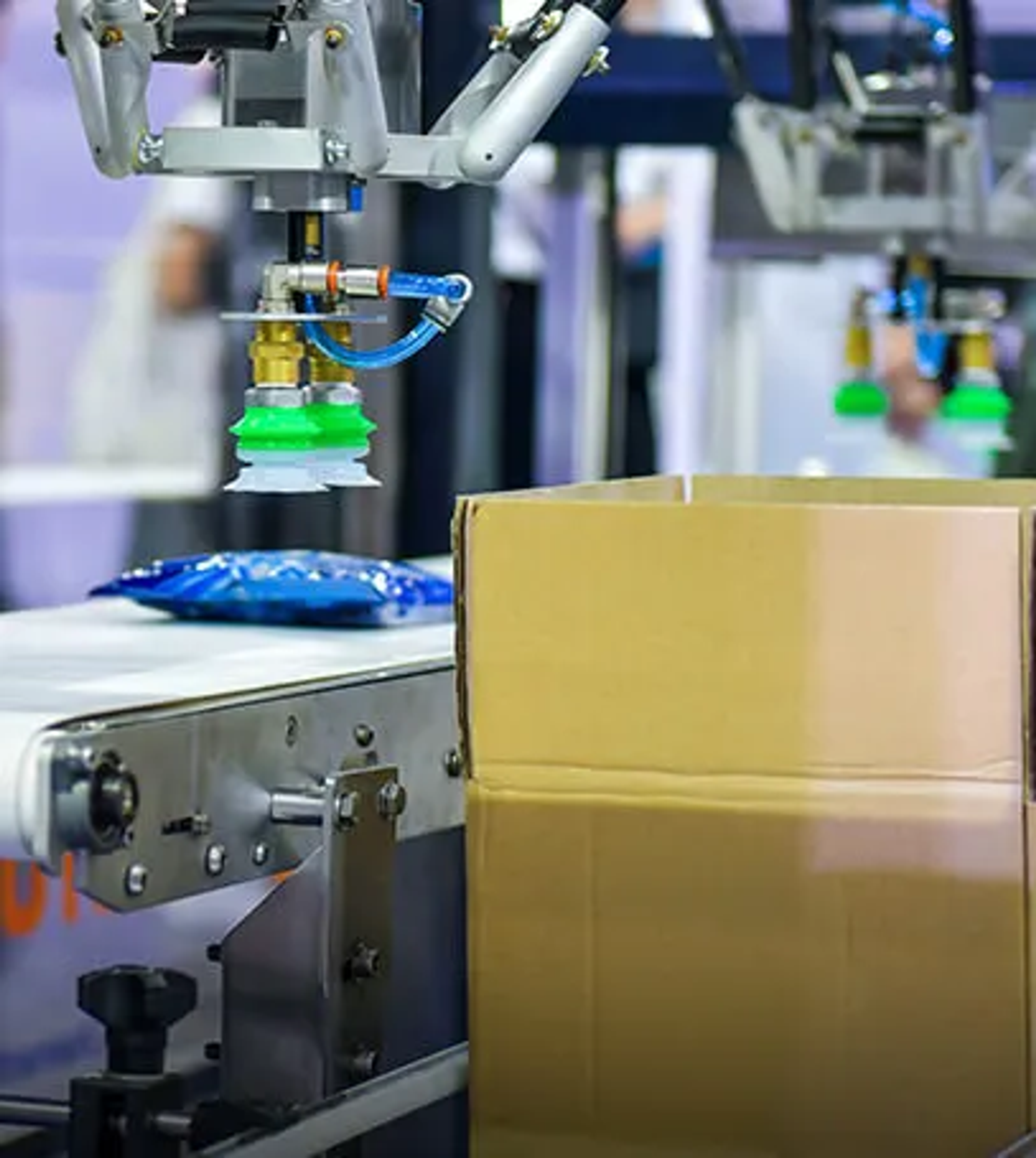
When the line drops packs at speed or slows every changeover, the question is which utility does which job. Compressed air belongs on actuation, sealing, and blow molding; vacuum belongs on pick and place, holding, and forming; and any air that touches food-contact packaging needs ISO 8573-1 Class 0 quality. The picker below matches your task to the right technology and spec.
Pick the task your line performs. The output is the right technology for it, the quality spec that applies, and the product path. Sanity check for a spec meeting, confirmed by an engineer against your line layout.
Choose a task above to see the right technology and quality spec.
Run the numbers yourself
Pneumatic actuation on forming, dosing, and sealing at line speed.
High-pressure PET stretch blow and extrusion blow air.
Cylinders, diverters, and vacuum grippers building cases.
Vacuum end effectors and pneumatic layer squaring.
Blow-on label application and air-assisted feeds.
Suction cups moving product, film, and cartons every cycle.
Modified atmosphere flush extending shelf life on food lines.
Pressure decay and vacuum decay checks on sealed packages.
Four disciplines separate a line that holds speed from one that drops product and burns energy. None of this is gated behind a form.
Where compressed air touches food-contact packaging surfaces, film, trays, bottles, auditors apply the same standard as food processing: ISO 8573-1 with Class 0 oil-free air at the contact point. The full breakdown by class is on our food and beverage page.
A pick-and-place cell that loses vacuum mid-transfer drops product at line speed. Central vacuum sizing works from cups per head, cycle rate, and porosity of what you grip, with reserve capacity so one leaking cup does not slow the line.
Point-of-use filters and regulators drift out of spec as formats change. A quality map of the line, which drops feed actuation, which feed contact air, which feed instruments, keeps changeovers from quietly connecting the wrong air to the wrong task.
Compressed air is commonly the most expensive utility per package: DOE puts typical leak loss at 20 to 30 percent, and packaging halls full of quick-disconnects and festooned hoses sit at the high end. Leak surveys and shutting air off at idle stations show up directly in cost per case.
For a packaging hall running form-fill-seal and case packing, the setup we install most pairs a Sullair rotary screw for actuation air, an oil-free machine or point-of-use Class 0 supply for contact points, and a VSD central vacuum system replacing scattered venturi ejectors. The vacuum retrofit is usually the fastest payback in the building. Machine options are on the oil-free page and the industrial vacuum page.
Typical project: venturi to central vacuum retrofit
A common scenario in food packaging is a case packing line with a dozen or more venturi vacuum heads, all fed from plant air, where the compressor room becomes one of the largest electrical loads in the building. A typical Brabazon project logs the line for a week, then replaces the venturi supply with a VSD claw vacuum pump and manifold, keeping a couple of venturi heads on a hard-to-pipe cell. Compressed air demand on that line usually drops enough to shelve a planned compressor purchase, and dropped-pack faults fall because the central system holds vacuum through peak cycles. The energy math from the logging week is the template we use for venturi retrofit reviews.
Factory-trained technicians dispatch from 7 branches serving 14 metro areas with an under 2 hour average emergency response. Find your nearest branch:
Almost always both, doing different jobs: compressed air drives actuation, sealing, and blow-off, while vacuum does the picking, holding, and placing. The mistake that costs money is generating one from the other, running venturi vacuum off compressed air on every head, once a line has more than a few pick points.
At any point where air can touch food-contact packaging surfaces, yes: auditors expect ISO 8573-1 Class 0 there, same as food processing. Actuation air that never touches product can run on oil-injected machines with filtration, which is why splitting the line into an air quality map saves capital.
Venturi ejectors win on simplicity for one or two heads, but they consume compressed air constantly, which costs several times more per CFM than pump vacuum. Once a line runs several pick points most of a shift, a central vacuum pump usually pays for itself in energy within a year or two.
Stretch blow molding typically runs 435 to 580 psi high-pressure air for the blow phase, with lower pressure pre-blow, and it must be dry and oil-controlled to protect bottle clarity. Blow air recovery systems recycle part of that high-pressure air and are worth evaluating at scale.
It depends on the product: many MAP applications for baked goods and snacks run at 99 to 99.5 percent purity, while high-fat or oxygen-sensitive products push to 99.9 percent or better. On-site membrane or PSA generation fed from your compressed air system covers this range and cuts cylinder and bulk contracts.
Brabazon supports compressors, vacuum pumps, and nitrogen generation from 7 branches serving 14 metro areas across Wisconsin, Illinois, Minnesota, and Missouri with an under 2 hour average emergency response. We have serviced industrial air since 1978 and stock OEM parts.
Send us your line layout or walk it with an engineer. You get a quality map of which tasks need Class 0 air, which need vacuum, and where the energy is leaking out.
Press Escape to close. Use the arrow keys to move through results.