Oil-free compressors
Class 0 oil-free machines for process air and instrument air applications in chemical facilities.
Spec Class 0 process air
Industry: Chemical processing
Chemical Plant Air Spec Plate
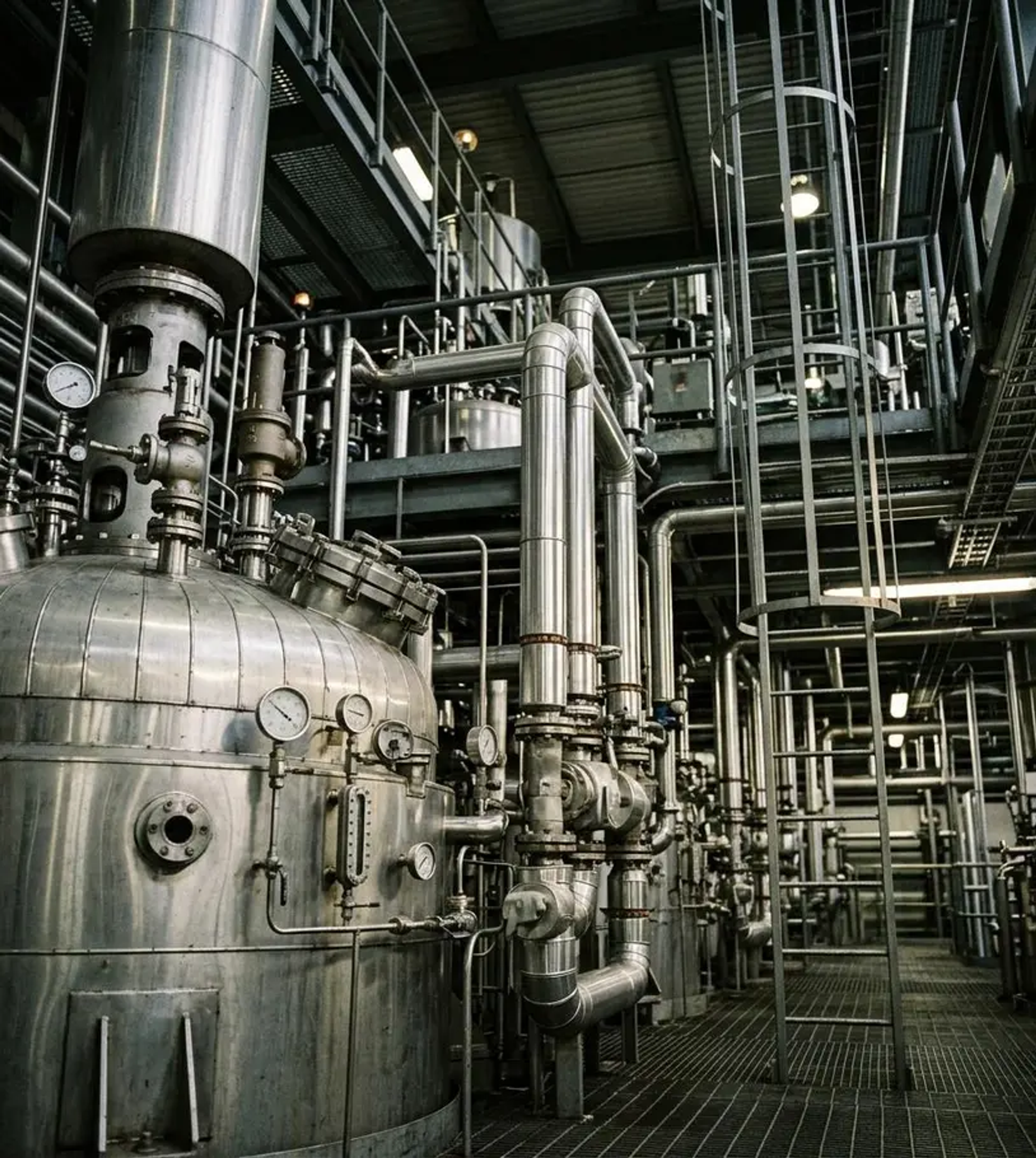
Chemical plants run two or three distinct compressed air qualities: instrument air at a dew point low enough to prevent condensation in control lines, process air at oil-free quality where air enters reactors or product streams, and utility air for maintenance and general use. Nitrogen for blanketing and purging often comes from an on-site generator fed by the compressed air system. Getting the specification right for each circuit is critical because a quality failure in instrument air causes process upsets; a quality failure in process air can affect product.
The instrument air specification governs the quality of air reaching pneumatic instruments and control valves. Understanding the split between instrument air, process air, and utility air determines the equipment configuration.
Three compressed air circuits in a chemical plant
Instrument air: Desiccant-dried to negative 40 F pressure dew point per ISA-7.0.01. Typically oil-injected compressors with high-efficiency filtration, or oil-free. N+1 configuration with auto-failover.
Process air: Oil-free Class 0 (ISO 8573-1) where air enters reactors or product streams. Dedicated oil-free machines or a separate circuit from the instrument air package.
Utility air: Standard oil-injected rotary screw with refrigerated drying and basic filtration for maintenance tools, flushing, and construction. Not connected to instrument or process circuits.
See our power generation instrument air page for additional N+1 configuration guidance applicable to process facilities.
Run the numbers yourself
Instrument air at ISA-7.0.01 spec operating actuators, positioners, and control valves throughout the process.
Oil-free process air supplied to reactors, oxidation, and fermentation processes where air purity is a process requirement.
On-site nitrogen generation for tank blanketing, vessel purging, and inert atmosphere in flammable service.
Pneumatic dense-phase and dilute-phase transfer of powders, granules, and bulk chemical intermediates.
Instrument air and utility air for pneumatic cooling controls and heat exchanger bypass systems.
Utility compressed air for maintenance tools, line purging, and construction and turnaround support.
High-purity air for gas chromatographs, analyzers, and laboratory instruments requiring clean, dry carrier gas.
Safety instrument systems and emergency blowdown actuators fed from a separate, monitored instrument air header.
Four disciplines keep a chemical plant instrument air system from contributing to process upsets, false trips, and quality failures.
ISA-7.0.01 sets the quality limits for industrial instrument air: pressure dew point, oil content, and particle size. Most chemical facilities target a pressure dew point at or below negative 40 F, oil content below 1 ppm, and particles below 40 microns. Desiccant drying and a coalescing filter train on the instrument header achieves this from a standard oil-injected or oil-free compressor.
When compressed air enters a reactor, an oxidation vessel, or any process stream, oil contamination can affect product quality, catalyst life, or downstream processes. ISO 8573-1 Class 0 oil-free compressors eliminate hydrocarbon carryover at the source. This is often required in fine chemical, pharmaceutical chemical, and food-grade chemical manufacturing.
Chemical process instruments run continuously. A loss of instrument air pressure stops pneumatic control valves and can trigger emergency shutdowns. N+1 compressor configurations with automatic standby failover are standard for instrument air in continuous process plants. Brabazon designs and installs duplex and triplex configurations sized for the facility criticality level.
Nitrogen demand in chemical plants for blanketing, purging, and inerting often justifies on-site generation. PSA generators at 99 to 99.999 percent purity, or membrane units at 95 to 99.5 percent, eliminate bulk deliveries and cylinder handling. The break-even on capital versus supply contract is typically 12 to 30 months depending on purity requirement and consumption volume.
Where compressors, dryers, or nitrogen units sit in or near classified areas, the equipment location, enclosure rating, and motor and control selection must match the classification your facility engineer defines. Brabazon configures packages to the classification and installation requirements provided by the owner's engineer. We do not determine area classification or make code-compliance determinations; those stay with your engineer of record, and we build the package to suit.
For a mid-size specialty chemical plant, the instrument air package we configure most includes two oil-free rotary screw compressors in N+1 with a twin-tower desiccant dryer on a common header, coalescing filtration, and an automatic standby controller. A separate utility air compressor handles maintenance load without affecting the instrument circuit. Nitrogen generation for blanketing runs from the clean instrument air header through a PSA generator sized to the peak purge demand. See the oil-free compressor page and the dryers and filters page for equipment details.
Typical project: Chemical processing
A common scenario in chemical processing is a plant running a single compressor on instrument air with no automatic standby. A compressor failure during a maintenance window can force an emergency shutdown of several process units while a rental unit is deployed, and that downtime cost often exceeds the price of a permanent standby machine. A typical project installs a properly sized standby compressor with an automatic failover controller and upgrades the desiccant dryer to a twin-tower heated regeneration system capable of holding the negative 40 F dew point year-round. The result is an instrument air header that rides through a single compressor failure without a process trip.
Factory-trained technicians dispatch from 7 branches serving 14 metro areas with an under 2 hour average emergency response. Find your nearest branch:
ISA-7.0.01 is the reference standard for industrial instrument air quality. It specifies dew point, particle size, and oil content limits for compressed air used to operate pneumatic instruments and control valves. Most chemical plants target a pressure dew point of negative 40 F and oil content below 1 ppm to meet this standard.
It depends on where the air goes. Instrument air and utility air that does not enter the process can often run on oil-injected compressors with high-efficiency filtration to meet ISA-7.0.01 oil limits. Process air that enters reactors or product streams typically requires oil-free Class 0 supply to eliminate contamination risk.
On-site generation is typically more economical above a few hundred thousand cubic feet of nitrogen per month, or when the purity requirement is moderate and consistent. PSA units cover 99 to 99.999 percent purity. Below 99.5 percent, membrane systems are often the simpler technology. The break-even against bulk supply depends on your purity requirement and consumption rate.
N+1 means the installed compressor capacity includes one extra machine beyond what is needed to supply the full demand. If N machines can supply the demand, N+1 machines are installed so that one failure leaves the system running at full supply. This is the minimum redundancy standard for instrument air in most continuous chemical process plants.
Compressors and dryers serving classified areas must match the area classification your facility engineer defines, which can drive the equipment location, enclosure rating, and motor or control selection. Brabazon configures packages to the classification and installation requirements provided by the owner's engineer; we do not determine area classification or make code-compliance determinations, which remain the responsibility of your engineer of record.
Brabazon has supported chemical processing facilities from 7 branches serving 14 metro areas since 1978 and has been the authorized Sullair dealer since 1984. We provide emergency service, planned maintenance contracts, and system audits for continuous-process chemical facilities.
Tell us your process air demand, instrument air specification, nitrogen purity requirement, and criticality level. We design the instrument air package, process air supply, and nitrogen generation to match your facility.
Press Escape to close. Use the arrow keys to move through results.