Oil-free compressors
Class 0 oil-free machines for paper web contact and coating applications.
Spec Class 0 air
Industry: Paper and pulp
Paper Mill Air and Vacuum Spec Plate
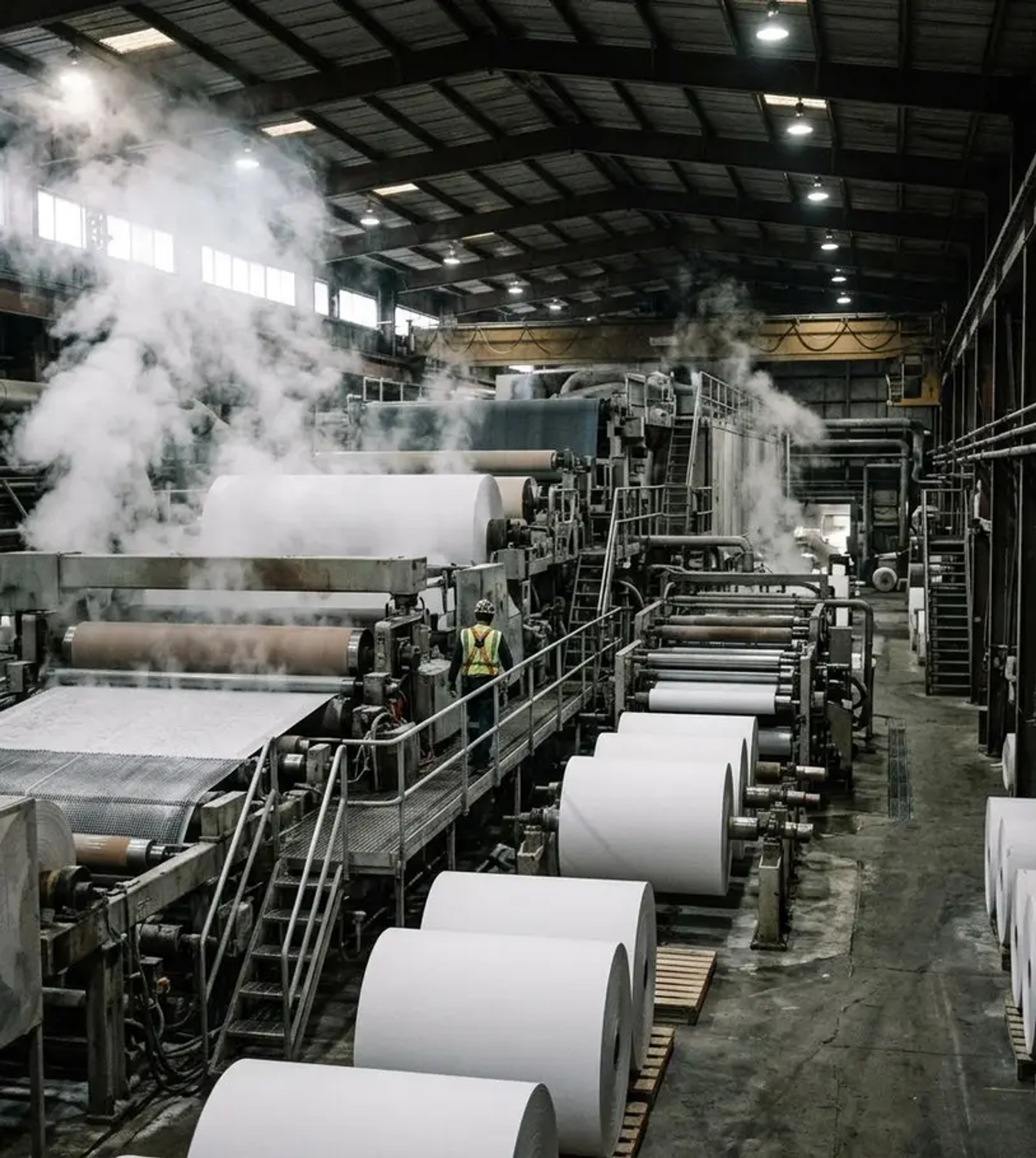
A paper mill runs two fundamentally different compressed air circuits: contact air for the web and coatings at oil-free quality, and utility air for controls and cylinders. Instrument air runs on a dedicated desiccant-dried circuit to hold the pressure dew point required by ISA-7.0.01. The wet end and press section use vacuum, not compressed air, for water removal. Getting the specification right for each circuit prevents the defect and reliability problems that come from using the same air quality for all applications.
The two major circuits in a paper mill air system require different equipment and quality specifications. Understanding the split between contact air and utility air is the first step in system design.
Two circuits, two specifications
Circuit 1: Contact and sheet air - Oil-free Class 0. Any air reaching the web, coating station, calender, or sheet floatation zones. Typically 20 to 40 percent of total mill demand.
Circuit 2: Utility and instrument air - Oil-injected with filtration for general utility. Desiccant-dried to negative 40 F pressure dew point for instrument and control air per ISA-7.0.01. Typically 60 to 80 percent of total demand.
Vacuum system: Sized separately from compressed air. Suction rolls, press felts, and flat boxes draw from a central vacuum plant sized to the machine width, speed, and basis weight range.
For combined load estimates, contact us for a mill-scale audit. Learn about compressed air audits.
Run the numbers yourself
Oil-free air supporting the web over turning rolls and through non-contact drying sections.
Instrument air at mill-spec dew point driving actuators, valves, and process controls throughout the machine.
High-vacuum system for suction rolls and press felts, pulling water from the sheet.
Compressed air for cleaning rolls, blowing defects, and operating coating applicators.
Controlled air blasts guiding the sheet tail through the machine at startup and after breaks.
Compressed air for consistency controls, dilution valves, and screening equipment in the pulp preparation area.
Aeration blowers and compressed air for water and effluent treatment systems on site.
Utility compressed air for shop tools, felt cleaning, and equipment maintenance across the mill.
Four disciplines separate a mill with reliable production from one that chases moisture alarms and instrument failures.
Any compressed air that contacts the paper web or coating materials requires oil-free supply. Oil contamination causes sheet defects, coating adhesion failures, and print quality issues that are expensive to diagnose and impossible to fix after the roll is wound. The oil-free requirement applies to air showers, sheet floatation, coating application air, and any blow that reaches the product side of the machine.
Unplanned compressor shutdowns stop production on machines that often run at a cost of thousands of dollars per hour. Paper mill air systems are typically designed N+1: enough capacity in the installed base that one machine can fail and the others carry the load while the repair is made. Hot standby configurations with automatic failover are common for instrument air.
Control air for process instruments and pneumatic valves must hold a pressure dew point low enough to prevent condensation in the lines at all ambient conditions. ISA-7.0.01 provides the reference standard for industrial instrument air. Most mill configurations target a pressure dew point of negative 40 F or better, which requires desiccant drying on the instrument circuit.
Suction rolls, vacuum presses, and vacuum flat boxes all need sustained vacuum at high flow rates to pull water from the sheet. These systems are sized separately from compressed air and typically use dedicated rotary claw or screw vacuum pumps matched to the roll geometry and machine speed. Central vacuum with VSD control matches draw to the actual demand as machine speed changes.
For a mid-size paper mill, the compressor room we typically configure includes dedicated oil-free machines on the contact air circuit with N+1 redundancy, plus oil-injected rotary screw units with refrigerated drying on the utility circuit. A twin-tower desiccant system on the instrument air header holds the pressure dew point specification year-round. All machines connect to a common ring main with zone valves separating the contact and utility circuits. See the oil-free compressor page and the industrial vacuum page for equipment details.
Typical project: Paper and pulp
A common scenario in paper and pulp is a mill experiencing repeated instrument air quality failures during winter months, causing pneumatic valve sticking and false process alarms. The root cause is often a refrigerated dryer running the instrument circuit: the dryer holds adequate dew point at summer conditions but cannot reach the required specification when incoming air temperatures drop. A typical project replaces the refrigerated dryer on the instrument circuit with a twin-tower heatless desiccant system and adds an automatic failover to the standby compressor. That holds the negative 40 F dew point year-round and lets the instrument header ride through a single compressor failure, heading off a production-disrupting control system investigation.
Factory-trained technicians dispatch from 7 branches serving 14 metro areas with an under 2 hour average emergency response. Find your nearest branch:
At any point where compressed air can contact the paper web or coating materials, oil-free air is required. This includes air showers, sheet floatation, calender cleaning, and coating applications. Utility air for pneumatic controls and cylinders that never touch the paper can run on oil-injected machines with proper filtration, which is why the system is typically split into two circuits.
Paper mill compressed air demand varies widely by mill type, speed, and machine count. A small specialty paper mill might use 500 to 1000 CFM continuously. A large multi-machine newsprint or packaging board mill can exceed 5000 CFM. Most mills run N+1 redundant compressor configurations to prevent unplanned production stops.
Industrial instrument air per ISA-7.0.01 typically targets a pressure dew point of negative 40 F. This prevents condensation in control air lines under the range of ambient temperatures the mill experiences. Twin-tower desiccant dryers, either heatless or heated, are the standard technology for this specification.
Vacuum is used at the wet end to pull water from the sheet on suction rolls, vacuum presses, and forming fabrics. It determines how much water the press section removes before the energy-intensive drying section. More efficient vacuum systems reduce steam energy in the dryers, which is a significant operating cost lever in paper making.
Brabazon has supported industrial mills from 7 branches serving 14 metro areas in Wisconsin, Illinois, Minnesota, and Missouri since 1978 and has been the authorized Sullair dealer since 1984. We provide emergency service, planned maintenance, and system audits for large continuous-process facilities.
Tell us your machine count, speed, and current compressor configuration. We assess the contact air split, instrument air dew point, vacuum system sizing, and redundancy level.
Press Escape to close. Use the arrow keys to move through results.