Industrial vacuum pumps
Rotary vane and claw vacuum for feed tables, transport belts, and register control on sheet-fed and web presses.
Spec press vacuum
Industry: Printing and converting
Pressroom Air and Vacuum Spec Plate
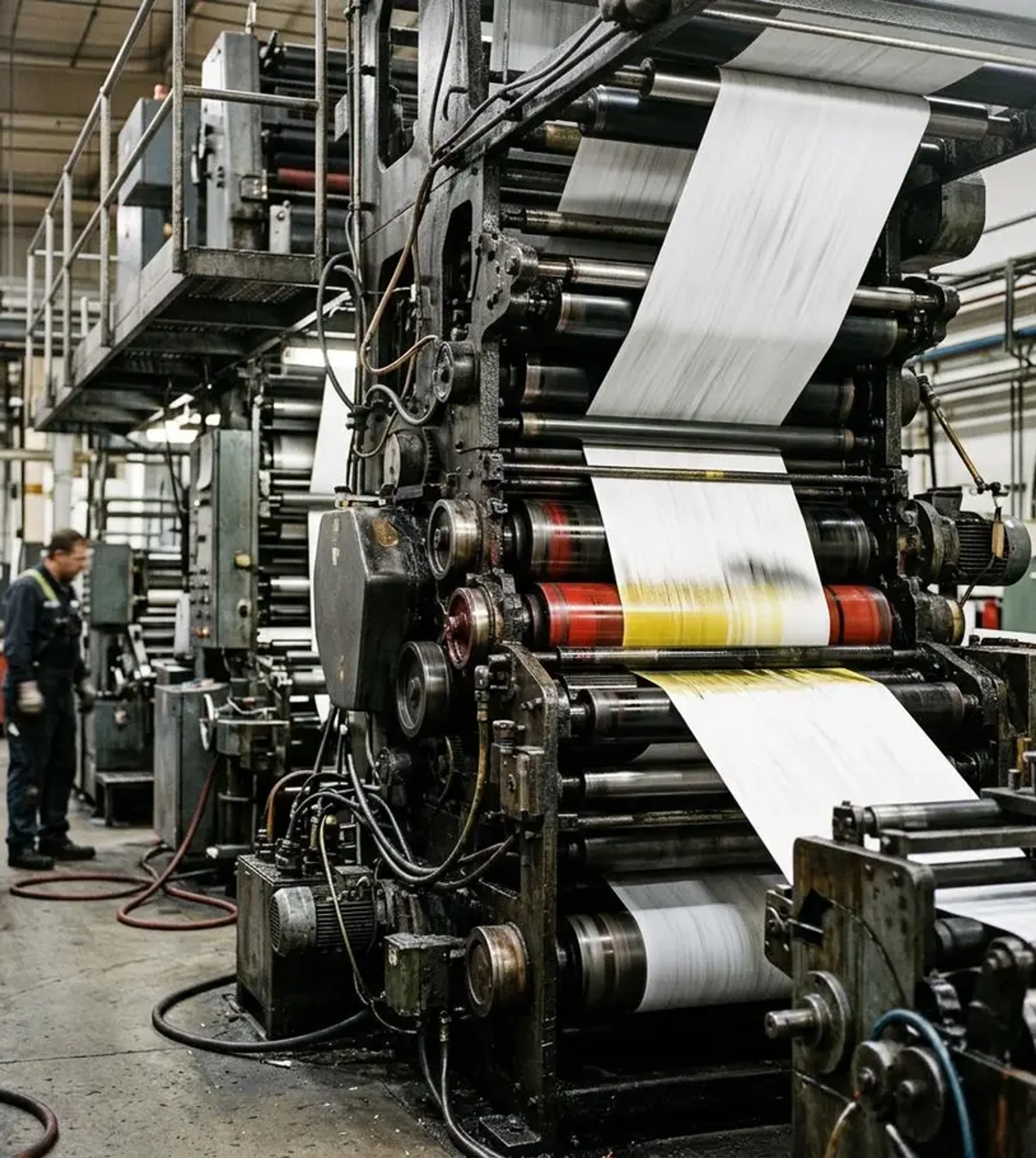
A printing and converting plant runs two utilities that decide print quality: compressed air that must reach the sheet clean and dry, and vacuum that holds every sheet in the same position as the press runs. Air feeds printheads, dampening systems, air knives, and static-control blow-off, so moisture and oil have to be removed by drying and filtration before they reach the sheet. Vacuum holds sheets to feed tables, transport belts, and register tables, and controls web tension on web presses. Sizing the drying to the point of use and the vacuum to the fastest sheet rate is what keeps registration repeatable.
Print quality depends on two things the utility system controls: air that reaches the sheet clean and dry, and vacuum that holds every sheet in the same position at speed. The specification splits by point of use.
Two utilities, split by point of use
Air, general pressroom: Rotary screw with refrigerated drying to a 38 F dew point and coalescing plus particulate filtration for cylinders, air knives, and blow-off.
Air, printheads and precision dampening: Desiccant drying to a negative 40 F dew point with tight filtration where inkjet jets or fine dampening cannot tolerate any moisture or oil.
Vacuum: Rotary vane or claw pumps, combined pressure and vacuum on the feeder or a central manifold, sized and controlled to the fastest sheet rate the press runs so hold-down stays steady.
Run the numbers yourself
See our packaging page for related converting and finishing line air and vacuum guidance.
Low-pressure blow-off floats and separates the top sheet in the pile so the feeder lifts one sheet at a time without doubles or misfeeds.
Vacuum holds sheets to feed tables and transport belts so each sheet reaches the first print unit in a repeatable position.
Stable vacuum on register and pull-lay tables keeps sheet position consistent, which is what makes color-to-color and front-to-back register repeatable.
Dry, oil-free filtered air protects inkjet printheads and jet nozzles from moisture and hydrocarbon contamination that clogs and misfires jets.
Clean air runs dampening system controls and air knives that remove residual moisture and debris from the sheet ahead of the next unit.
Air-flotation turn bars and vacuum rollers control web tension on web presses so the web tracks without wrinkles or wander.
Compressed air and vacuum feed and hold stock through die cutters, folder-gluers, and laminating nips where nip pressure and sheet control are critical.
Ionized air blow-off neutralizes static and clears dust from the sheet and web, which reduces feed faults and print defects on plastic and coated stock.
Four disciplines keep utility air and vacuum from showing up as register drift, print defects, and reject sheets.
Moisture and oil in pressroom air do not stay in the pipe. They reach printheads, dampening systems, and air knives, where they clog nozzles, contaminate ink and fountain solution, and mist onto the sheet. A dryer sized to the plant conditions plus a coalescing and particulate filter train keeps the air off the sheet clean, which directly lowers reject rates.
Refrigerated drying to a 38 F pressure dew point covers most pressroom air in a climate-controlled plant. Desiccant drying to a negative 40 F dew point is reserved for inkjet printheads, precision dampening, and any line that runs through cold or unheated space where a 38 F dew point would still condense. Matching the dryer to the point of use avoids both wet air and the cost of over-drying every line.
Register accuracy depends on every sheet arriving in the same position. That requires vacuum that holds steady as the press speeds up and slows down. Undersized or poorly controlled vacuum lets sheets shift at high sheet rates, which shows up as register drift. Sizing the vacuum pump and its control to the fastest sheet rate the press runs keeps hold-down consistent across the speed range.
Sheet-fed presses need both blowing air for sheet separation and vacuum for pick and transport. Combined pressure and vacuum pumps supply both from the press feeder. Where a plant runs several presses, a central blower and vacuum system with a manifold can replace individual on-board pumps and add redundancy, so a single pump fault does not stop a press.
For a sheet-fed pressroom, the package we configure most pairs a VSD rotary screw compressor with a refrigerated dryer and a coalescing and particulate filter train for general air, plus a small desiccant leg dried to a negative 40 F dew point for any inkjet or precision dampening lines. Vacuum comes from rotary vane or claw pumps sized to the fastest sheet rate, either as combined pressure and vacuum units on the feeder or as a central manifold serving several presses. See the rotary screw page, the dryers and filters page, and the industrial vacuum page for equipment details.
Typical project: Printing and converting
A common scenario in this industry is a sheet-fed plant that runs clean at low speed but drifts out of register when the press is pushed to full sheet rate. A typical project starts when the vacuum pump and its control cannot hold steady hold-down at speed, so sheets shift on the register table, and at the same time a refrigerated dryer feeding an inkjet coder lets enough moisture through to clog jets in a cold corner of the plant. Brabazon-configured equipment solves this by sizing the vacuum pump and control to the fastest sheet rate so hold-down stays constant across the speed range, and by adding a desiccant drying leg to a negative 40 F dew point on the printhead and coder lines. Register holds through the full speed range and printhead faults from moisture stop.
Factory-trained technicians dispatch from 7 branches serving 14 metro areas with an under 2 hour average emergency response. Find your nearest branch:
Moisture and oil carried in compressed air migrate into printheads, dampening systems, and air knives, where they cause nozzle clogging, ink and fountain solution contamination, and misting on the sheet. Drying the air to a stable dew point and filtering out oil and particulate protects print quality and reduces reject rates on both sheet-fed and web presses.
A refrigerated dryer holding a pressure dew point near 38 F is adequate for most pressroom air used on cylinders, air knives, and general blow-off in a climate-controlled plant. Desiccant drying to a negative 40 F dew point is used where air feeds inkjet printheads, precision dampening, or lines that run through unheated or cold areas where a 38 F dew point would still condense.
Vacuum holds sheets to feed tables, transport belts, and register tables so each sheet arrives at the print unit in the same position. On web presses vacuum controls web tension and holds the web on turn bars and rollers. Stable vacuum pressure directly affects register accuracy, so the pump and its control are sized to the fastest sheet rate the press runs.
Sheet-fed presses need both a blowing supply to separate the top sheet in the pile and a vacuum supply to pick and transport it. Combined pressure and vacuum pumps deliver both from one machine, which suits the press feeder. Where a plant runs several presses or wants central redundancy, a shared blower and vacuum system with a manifold can replace the individual on-board pumps.
Brabazon has supported printing and converting plants from 7 branches serving 14 metro areas since 1978 and has been the authorized Sullair distributor since 1984. We provide compressors, vacuum pumps, blowers, air treatment, and service across Wisconsin, Illinois, Minnesota, and Missouri, with an under 2 hour average emergency response.
Tell us your presses, sheet rates, stock types, and where inkjet or precision dampening air is needed. We match the compressor, drying, filtration, and vacuum to the point-of-use requirements so quality stays consistent at full speed.
Press Escape to close. Use the arrow keys to move through results.