Steel and Metals
Full guide to compressed air for metal fabrication: blasting, plasma, and laser applications.
See all metal fab applications
Application: Machine shops and machining centers
Machine Shop Air Spec Plate
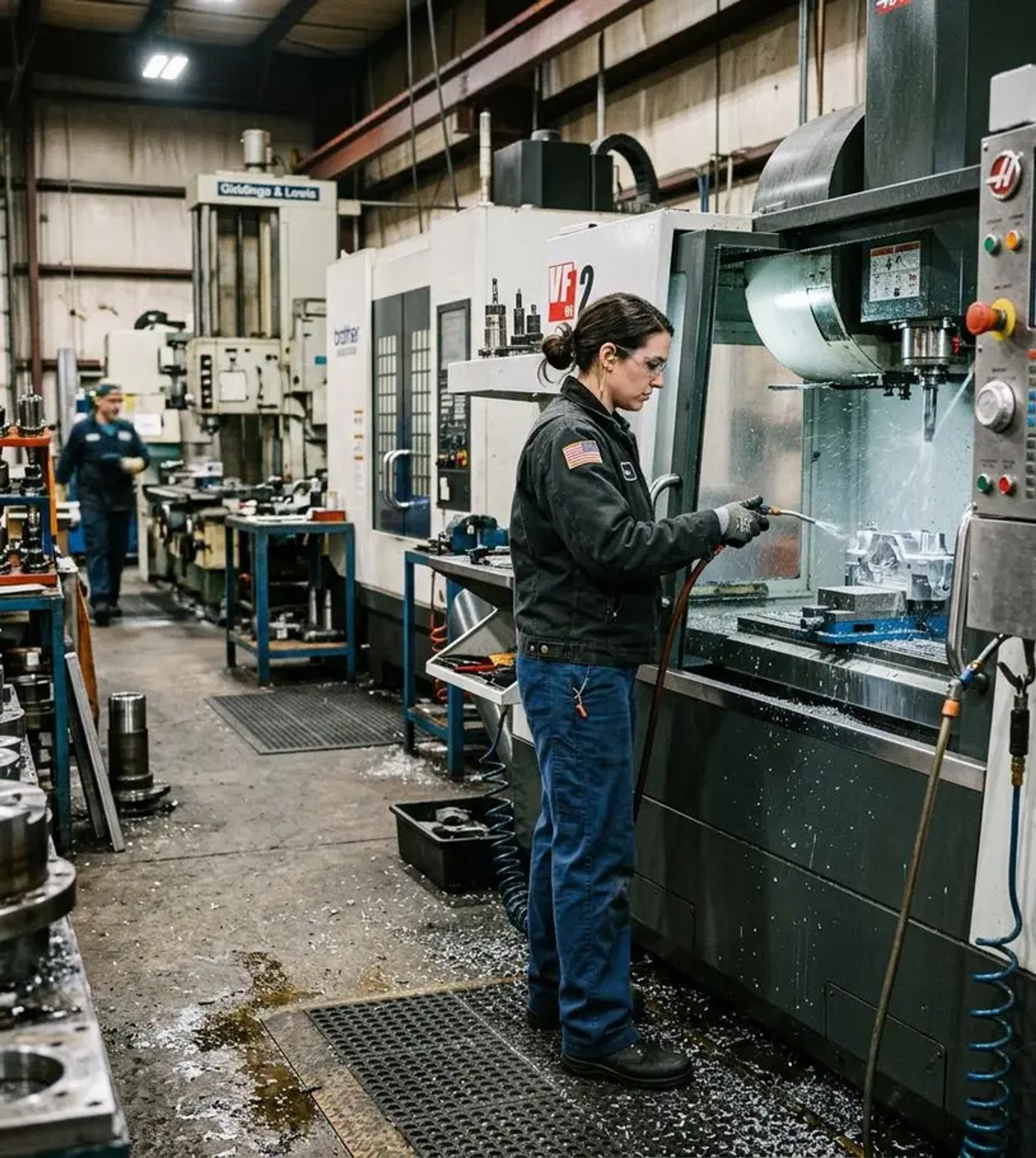
A machine shop air compressor needs to hold working pressure at every station during the simultaneous peak of a full shift. Most sizing mistakes come from adding up the nameplate CFM of every tool in the shop instead of the tools running at the same time. The table below gives typical CFM by tool type so you can estimate the realistic simultaneous demand.
Use these values to estimate simultaneous demand. Apply a diversity factor of 0.6 to 0.8 to the combined load because not all tools run at the same time. Add 20 percent reserve for the compressor size.
| Tool type | Typical CFM each | Pressure | Duty pattern |
|---|---|---|---|
| Air impact wrench (3/4 in drive) | 10 to 15 CFM | 90 psi | Intermittent |
| Air impact wrench (1/2 in drive) | 5 to 10 CFM | 90 psi | Intermittent |
| Air ratchet | 6 to 8 CFM | 90 psi | Intermittent |
| Chip blow-off gun | 5 to 15 CFM | 90 psi | Frequent, short bursts |
| CNC machining center (air functions) | 5 to 20 CFM | 80 to 100 psi | Continuous during cycle |
| Air drill | 3 to 6 CFM | 90 psi | Intermittent |
| Air grinder (4 to 6 in) | 20 to 35 CFM | 90 psi | Intermittent to continuous |
| Pneumatic chuck or vise | 2 to 5 CFM hold | 80 psi | Continuous while holding |
Multiply simultaneous tool count by their CFM, apply 0.6 to 0.8 diversity factor, and add 20 percent reserve.
Run the numbers yourself
High-torque impact tools for fixturing, assembly, and part handling at 90 psi.
Clearing machined chips from fixtures, parts, and work envelopes between operations.
Maintenance and assembly air tools running intermittently across the shift.
Tool change actuation, spindle purge, coolant system air, and door cylinders on CNC machines.
Compressed air atomizing coolant and mist lubricant at the cutting zone.
Blow-off and air-assisted wash systems cleaning machined parts before inspection.
Pneumatic chucks, vises, and collet closers requiring regulated air at the machine.
Touch-up painting, anti-rust coating, and part marking in the shop finishing area.
Four factors separate a machine shop air system that holds pressure at every station from one that drops pressure during busy shifts and shortens tool life.
Adding the nameplate CFM of every air tool in a machine shop always oversizes the compressor because not everything runs at the same time. Apply a diversity factor of 0.6 to 0.8 to the total connected load, which reflects the fraction of tools actually running simultaneously during a typical shift. Then add 20 percent reserve capacity. The result is the realistic compressor size for the shop.
A piston compressor suits a low-duty-cycle shop where the compressor runs less than 50 percent of the time: small tool rooms, maintenance bays, and shops with infrequent use. A rotary screw suits any shop running air tools continuously across a shift because it is rated for 100 percent duty cycle, generates less heat, has longer service intervals, and produces quieter operation.
Water in a machine shop compressed air system causes rust inside air tools, shortens motor life, and contaminates coolant systems. A refrigerated dryer on the compressor outlet is standard in any shop running air tools across a shift. The cost of the dryer is recovered in reduced tool maintenance and replacement within the first year in most active machine shops.
A machine shop air system sized correctly at the compressor can still fail at individual machines if the piping is undersized or has excessive pressure drops. Common causes are undersized headers, long runs of small pipe, too many fittings, and aging connections full of rust and debris. Correct piping design holds the specified pressure at every machine simultaneously, not just at the compressor outlet.
For a machine shop running 5 to 15 CNC machines plus hand tools, the setup we install most is a 25 to 75 HP rotary screw compressor with a refrigerated dryer and a ring main distribution system. VSD control saves energy when the demand shifts between shifts and weekends. For larger job shops running more machines across multiple shifts, a second compressor in a lead-lag configuration provides redundancy and handles demand peaks. See rotary screw compressors for sizing and the CFM calculator for your specific tool mix.
Typical project: machine shop air sizing
A common scenario in this industry is a job shop running eight CNC machining centers with persistent pressure complaints from operators during busy shifts. The root cause is often a pair of undersized piston compressors inherited from an earlier, smaller shop configuration: both units run at 100 percent duty cycle during peak demand and still cannot hold 90 psi at the far end of the distribution. A typical project replaces the piston units with a single 50 HP rotary screw compressor plus a refrigerated dryer and repairs the distribution ring main. Pressure then holds above 90 psi at every machine across all shifts, tool complaints stop, and maintenance cost drops by retiring the two piston units. Brabazon sizes and installs the compressor, dryer, and piping for this kind of upgrade.
Factory-trained technicians dispatch from 7 branches serving 14 metro areas with an under 2 hour average emergency response. Find your nearest branch:
Machine shop compressed air demand depends on the tools running simultaneously. Air impact wrenches draw 5 to 12 CFM each, air ratchets 6 to 8 CFM, chip blow-off guns 5 to 15 CFM, and machining centers typically 5 to 20 CFM for tool changes and coolant systems. Add the simultaneous loads with a diversity factor of 0.6 to 0.8, then add 20 percent reserve. Most machine shops land between 50 and 250 CFM depending on shop size and shift schedule.
For shops running air tools most of the shift, yes. Rotary screw compressors run at 100 percent duty cycle, generate less heat, require less maintenance, and operate more quietly than piston units. The piston compressor is the better choice for shops with low or intermittent air use, such as a tool room or maintenance bay running tools less than 50 percent of the time.
Yes, for any shop running air tools across a shift. Moisture in the compressed air causes rust inside air tools, shortens motor life, and can contaminate machined parts and coolant systems. A refrigerated dryer matched to the compressor CFM is standard equipment for any active machine shop.
Most machine shop air tools run at 80 to 100 psi. A compressor set to 100 to 125 psi provides enough margin to hold tool pressure under simultaneous use and through the distribution piping. Higher tool change pressures on machining centers are specified in the machine manual and are usually within the 80 to 100 psi range.
Signs of an undersized machine shop compressor include pressure drop at air tools during busy periods, the compressor running continuously without recovery time, overheating shutdowns during heavy use, and complaints from machinists about weak air tools. A capacity audit from Brabazon measures actual demand and compares it to installed capacity.
Brabazon has supported machine shops and precision machining operations from 7 branches serving 14 metro areas since 1978. Factory-trained technicians dispatch with an under 2 hour average emergency response and we have been the authorized Sullair dealer since 1984.
Tell us your machine count, tool mix, and shift schedule. We size the compressor, dryer, and piping layout for the demand you actually run.
Press Escape to close. Use the arrow keys to move through results.