CNC Machining and Routing Air
Spindle air, tool change, chip blow-off, and holddown sizing for CNC routers and machining centers.
Size CNC air
Industry: Wood products and woodworking
Wood Products Air Spec Plate
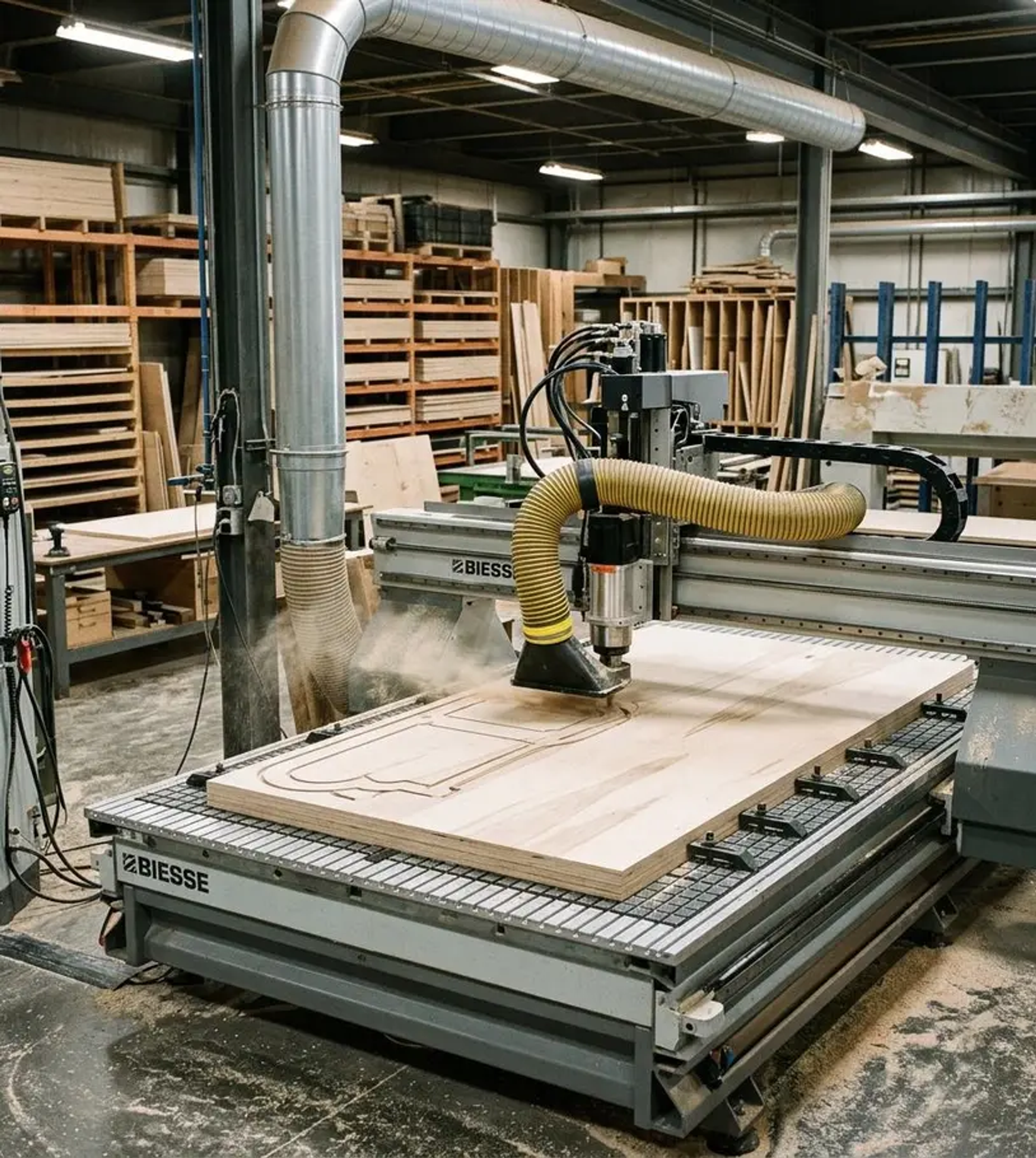
A wood shop running nailers, a spray booth, and a CNC router has three different air quality requirements on the same header. Nailers need volume and pressure. The spray gun needs dry oil-free air or the finish fails. The CNC router needs reliable pressure and a separate vacuum source for the holddown table. This page covers sizing for all three from one compressor room. For CNC routing specifically, the CNC machining guide covers the air functions and holddown system in detail.
Starting points by application. Add simultaneous loads and 20 percent margin before sizing a compressor. Use the CFM calculator for a combined shop estimate.
| Application | Typical CFM | Pressure | Notes |
|---|---|---|---|
| Brad and finish nailers | 2 to 4 CFM each | 70 to 100 psi | Intermittent duty |
| Framing nailers | 4 to 6 CFM each | 100 to 120 psi | Intermittent |
| HVLP spray gun | 6 to 18 CFM each | 30 to 45 psi at gun | Continuous while spraying |
| Conventional spray gun | 10 to 25 CFM each | 50 to 90 psi at gun | Continuous |
| CNC router (air functions) | 10 to 25 CFM | 80 to 100 psi | Continuous; holddown is separate vacuum |
| Air sander (orbital) | 5 to 10 CFM each | 90 psi | Intermittent |
| Air sander (belt) | 15 to 25 CFM each | 90 psi | Continuous while running |
Run the numbers yourself
Application-Specific Guide
Framing, finish, and brad nailers at 70 to 100 psi, the highest volume in cabinet and furniture shops.
HVLP and conventional spray guns for stain, lacquer, and waterborne paint in booths and open areas.
Spindle cooling, pneumatic tool changes, and vacuum holddown tables on production routers.
Orbital, belt, and random-orbit air sanders for production and finishing operations.
Air cylinders clamping panels and doors during glue-up and edge banding.
Saw arbor functions, chip conveying, pneumatic controls, and equipment cleaning at production sawmills.
Air-powered hoists, slides, and transfer stations moving slabs and panels.
Clearing machines, fixtures, and parts between operations throughout the shift.
Four disciplines separate a shop where the spray line runs cleanly from one that blames the gun for finish failures caused by the compressor room.
Water in air lines causes fish-eye, blushing, and adhesion failures in lacquer and waterborne coatings. A refrigerated dryer handles the baseline. Waterborne finishes and high-humidity seasons push many shops toward a desiccant dryer on the spray circuit. The cost of a dryer is far less than a batch of rework.
CNC routers use air for spindle cooling, pneumatic tool changes, and often for the vacuum holddown system. Most single-spindle routers need 10 to 25 CFM at 80 to 100 psi for the air functions. The vacuum pump on the holddown table is a separate system that must be sized independently from the compressed air.
Production sawmills run compressed air for saw arbor functions, pneumatic controls, and chip handling. The demand is often high continuous CFM at moderate pressure. Rotary screw compressors suit sawmill duty because they run at 100 percent duty cycle indefinitely, unlike piston units that require rest time between cycles.
Waterborne and UV-cured finishes are sensitive to oil contamination from the air supply. A TUV-certified oil-free compressor or an oil-injected machine with a high-efficiency coalescing filter train eliminates the risk. The oil-free path simplifies maintenance when the spray line is the primary air demand.
For a production furniture or cabinet shop, the starting point we recommend is a 25 to 50 HP rotary screw compressor with a refrigerated dryer serving nailers, presses, and material handling. Spray finishing runs from the same header with a coalescing filter and, for waterborne products, a desiccant polisher at the spray booth. CNC routers need their own sizing pass because the vacuum holddown table is a separate system from the compressed air. For that, see the CNC routing guide. Sawmill operations step up to 100 HP and above to serve pneumatic controls and high-volume utility air continuously across the full shift.
Typical project: wood finishing air quality
A common scenario in this industry is a cabinet manufacturer running a large piston compressor on a spray finishing line and seeing chronic fish-eye in lacquer during humid summer months. The usual root cause is inadequate moisture removal: the piston tank discharges wet air at the spray gun. A typical project replaces the piston unit with a 25 HP rotary screw and a refrigerated dryer, plus a desiccant polisher at the spray booth inlet. Finish rejects fall sharply within the first humid season, and the spray crew stops fighting moisture-related callbacks on finished cabinets. Brabazon sizes and installs the compressor, dryer, and point-of-use filtration for this kind of finishing upgrade.
Factory-trained technicians dispatch from 7 branches serving 14 metro areas with an under 2 hour average emergency response. Find your nearest branch:
Add the CFM of the tools you run at the same time, not all the tools in the shop. Two finish nailers and a spray gun running together need roughly 20 to 30 CFM at 90 psi, which a 5 to 10 HP rotary screw handles. Add a CNC router and the demand steps up to 40 to 60 CFM. Size for simultaneous use, not the nameplate total of every tool on the wall.
For spray finishing, you need clean, dry, oil-free air at the gun. This means either an oil-free compressor or an oil-injected machine with a refrigerated dryer and coalescing filtration. Nailers and actuators are not sensitive to oil content and run fine on a standard oil-injected compressor. Splitting the spray circuit from the shop circuit is common in production shops.
A rotary screw in the 5 to 25 HP range with a refrigerated dryer and a coalescing filter at the booth inlet is the standard setup. For waterborne products, add a desiccant polisher at the booth. Size from the gun CFM: an HVLP gun uses 6 to 18 CFM depending on the product and tip size.
Sawmills need continuous-duty equipment because the demand runs most of the shift. Rotary screw compressors are suited to this because they run at 100 percent duty cycle indefinitely. Sawmill demand tends to be moderate pressure, 80 to 120 psi, at higher CFM volumes for controls, chip handling, and arbor functions.
Brabazon has served wood products and woodworking operations from 7 branches serving 14 metro areas since 1978. Our factory-trained technicians dispatch with an under 2 hour average emergency response and we have been the authorized Sullair dealer since 1984.
Tell us what you spray, what you run on a CNC, and how many fastening stations run at once. We size the compressor, dryers, and circuit layout for the shop you have.
Press Escape to close. Use the arrow keys to move through results.