Wood Products and Woodworking
Full guide to compressed air for wood shops and wood products plants.
See wood products air guide
Application: CNC routing and machining
CNC Machine Air Spec Plate
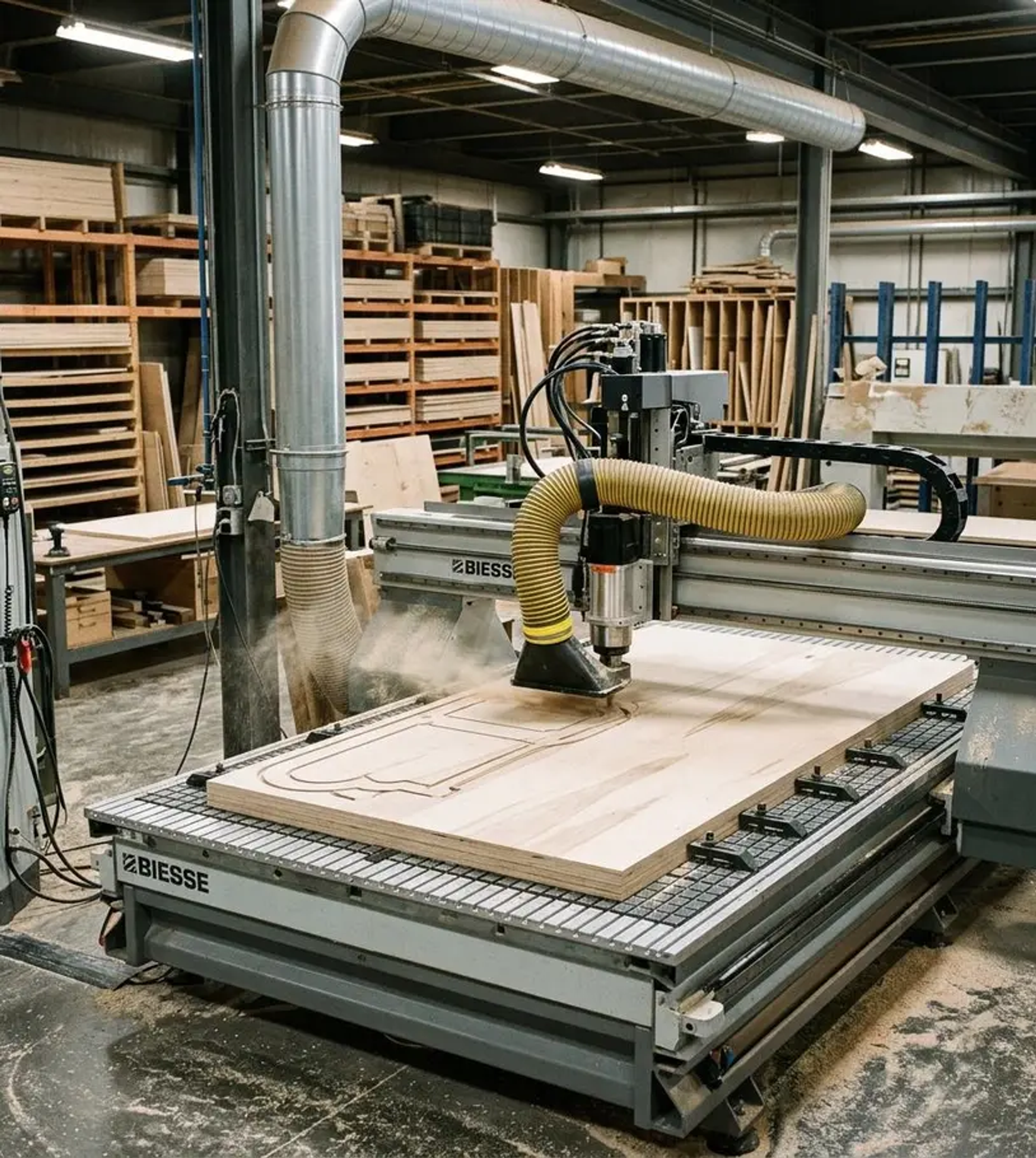
A CNC router has two separate utility systems that are commonly confused: compressed air for the spindle, tool changer, and chip blow-off, and vacuum for the holddown table. Getting both sized correctly is critical because an undersized compressor causes tool change failures, and a venturi holddown running off compressed air costs several times more in energy than a dedicated vacuum pump. The guide below covers both.
CNC routers and machining centers use compressed air for several different functions with different demand patterns. The holddown table is a vacuum system, separate from the compressed air.
| CNC function | System | Typical demand | Pressure or vacuum level |
|---|---|---|---|
| Spindle cooling and purge | Compressed air | 2 to 5 CFM continuous | 80 to 100 psi |
| Pneumatic tool change (ATC) | Compressed air | 3 to 8 CFM per event, brief | 80 to 100 psi minimum |
| Chip blow-off | Compressed air | 5 to 15 CFM intermittent | 80 to 100 psi |
| Pneumatic edge clamps | Compressed air | 2 to 5 CFM during clamping | 80 psi |
| Holddown table | Vacuum pump (separate) | Size to table area and porosity | 10 to 25 in-Hg typical |
Combined compressed air demand per router: 10 to 25 CFM at 80 to 100 psi. Check your machine manufacturer specification plate for exact values.
For holddown vacuum sizing, contact us: table area, spoilboard porosity, and material type determine the vacuum pump CFM.
Run the numbers yourself
Compressed air cooling the spindle bearing zone and purging chips and dust from the tool path.
ATC systems using compressed air to actuate tool release and clamping at every tool change event.
Clearing chips and dust from the work surface, part, and spoilboard between passes and operations.
Dedicated vacuum pump holding panels, sheets, and parts to the spoilboard during machining.
Pneumatic edge clamps and fixture actuators positioning work before and during the cutting cycle.
Compressed air assist jets directing chip and dust flow into the dust collection system.
Safety enclosure doors, chip guards, and tool magazine doors operated by compressed air cylinders.
Production routing centers with multiple spindles and tool carousels requiring higher simultaneous CFM.
Four air quality and sizing disciplines prevent the tool change failures, spindle damage, and holddown problems that shut down CNC production.
The most common sizing mistake on CNC routers is combining the compressed air demand and the holddown vacuum demand into one number. They are different technologies from different machines. The compressor supplies the spindle, tool changer, and blow-off. A vacuum pump supplies the holddown table. Size them separately and do not attempt to generate holddown vacuum from compressed air through venturi ejectors: the energy cost is prohibitive at production cycle rates.
Water in the compressed air supply to a CNC router deposits in the ATC collet mechanism and air bearings over time, causing corrosion and sticking that leads to tool change failures and spindle damage. A refrigerated dryer on the compressed air supply is standard for any CNC installation running production cycles.
The tool change is the highest instantaneous air demand in most CNC operations: the ATC fires at one moment and draws a burst of air. If the compressor system cannot hold pressure through the tool change event, the collet may not release or clamp correctly, leading to tool misfires or crashes. Size the compressor and tank volume to hold pressure through the tool change cycle.
A dedicated vacuum pump produces holddown force at far lower energy cost per CFM than a venturi generator running off compressed air. For a CNC router running most of a shift, a properly sized rotary vane or claw vacuum pump pays for itself versus the venturi option within a year or two in compressed air energy savings alone. For occasional or part-time routing, the venturi is simpler but the long-term cost is higher.
For a shop running one to three CNC routers, the setup we install most is a 10 to 25 HP rotary screw compressor with a refrigerated dryer serving the routers and any other shop tools on the same header. The holddown table runs from a dedicated rotary vane or claw vacuum pump sized to the table square footage and the material porosity. For a production panel shop running five or more routers, a larger rotary screw and a central vacuum plant with VSD control match the output to the actual demand. See rotary screw compressors and industrial vacuum pumps for the product options.
Typical project: CNC router air reliability
A common scenario in this industry is a panel shop seeing intermittent tool change failures and occasional spindle alarms on a CNC router. The root cause is often a small piston compressor running at 100 percent duty cycle that cannot hold 80 psi at the machine during the tool change burst: pressure at the ATC drops to around 60 psi, below the manufacturer minimum for reliable collet operation. A typical project replaces the piston unit with a 10 HP rotary screw compressor and adds a refrigerated dryer. Pressure then holds above 90 psi at the machine throughout the shift, tool change failures stop, and the compressor runs at roughly 60 percent duty cycle with headroom to add a second router. Brabazon sizes and installs the compressor and dryer for this kind of CNC air upgrade.
Factory-trained technicians dispatch from 7 branches serving 14 metro areas with an under 2 hour average emergency response. Find your nearest branch:
A CNC router typically needs 10 to 25 CFM at 80 to 100 psi for its compressed air functions: spindle cooling, pneumatic tool changes, and chip blow-off. The vacuum holddown table is a separate system requiring a vacuum pump, not a compressor. For the compressor, size from the machine specification plus any simultaneous shop tools, and add 20 percent reserve.
A CNC router holddown table uses vacuum, not compressed air, to hold parts to the spoilboard. The vacuum is generated by a dedicated vacuum pump, which must be sized separately from the compressed air system. Compressed air is used for spindle cooling, tool changes, and chip blow-off. The two systems are independent.
Most CNC router air functions run at 80 to 100 psi. Check the machine manufacturer specification for the minimum and maximum operating pressure. The ATC collet actuator typically specifies a minimum pressure to guarantee correct tool release and clamping. Operating below that minimum pressure causes tool change reliability problems.
Tool change failures on CNC routers most often trace to one of three compressed air causes: insufficient pressure at the ATC during the change event (pressure drop under load), moisture corrosion in the collet mechanism from a missing or failed dryer, or a compressor with insufficient CFM that drops pressure during the tool change burst. Check the supply pressure at the machine under load first.
Yes, if the compressor has enough CFM for both simultaneously and the spray circuit has a dedicated coalescing filter and dryer station. The CNC functions do not require oil-free air, but the spray gun does. Separating the spray circuit with its own filtration is the practical solution rather than running an oil-free compressor for the whole shop.
Brabazon has supported woodworking and wood products operations from 7 branches serving 14 metro areas since 1978. Factory-trained technicians dispatch with an under 2 hour average emergency response and we have been the authorized Sullair dealer since 1984.
Tell us your router or machining center model, number of machines, and shift schedule. We size the compressor and vacuum pump from the machine specifications.
Press Escape to close. Use the arrow keys to move through results.