
Water and compressed air are a destructive combination. Every cubic foot of ambient air contains moisture - and when that air is compressed, moisture concentrates and condenses throughout your system. Without proper drying, you get corrosion in your piping, water in your pneumatic tools and controls, contaminated end products, and frozen lines in winter. The consequences range from increased maintenance costs to production shutdowns to product recalls.
Brabazon supplies and services the full range of compressed air drying and filtration equipment for industrial facilities throughout Wisconsin, Illinois, Minnesota, and Missouri. This guide explains how compressed air moisture works, what your drying options are, and how to select the right dryer for your specific application and environment.
In this article
Why Moisture in Compressed Air Is So Damaging
Ambient air at 70°F and 75% relative humidity contains about 1.2 gallons of water per 1,000 cubic feet. When that air is compressed to 100 PSI, the same moisture is now packed into roughly 1/8 the volume - and as the compressed air cools downstream of the compressor, that moisture condenses into liquid water throughout your system.
The effects are severe and cumulative. Liquid water accelerates corrosion in steel and iron piping, shortening your distribution system's life. It washes lubricant out of pneumatic tools and cylinders, causing premature wear. In process applications, water contamination can destroy product batches - particularly in food and beverage, pharmaceutical, and electronics manufacturing. In cold climates, moisture freezes in outdoor piping and drain valves, blocking airflow entirely.
ISO 8573 classifies compressed air quality by moisture content into pressure dewpoint classes ranging from Class 1 (-94°F dewpoint, for critical semiconductor applications) to Class 6 (no requirement). Understanding your required dewpoint class is the starting point for selecting the right dryer.
Refrigerated Air Dryers: The Workhorse for General Industry
Refrigerated air dryers are the most widely used compressed air drying technology in general manufacturing and industrial applications. They work by cooling compressed air to approximately 35 to 50°F, causing moisture to condense and drain out before the air is reheated and delivered to the system. This typically achieves a pressure dewpoint of around 35 to 40°F - sufficient for most industrial applications operating in climate-controlled facilities.
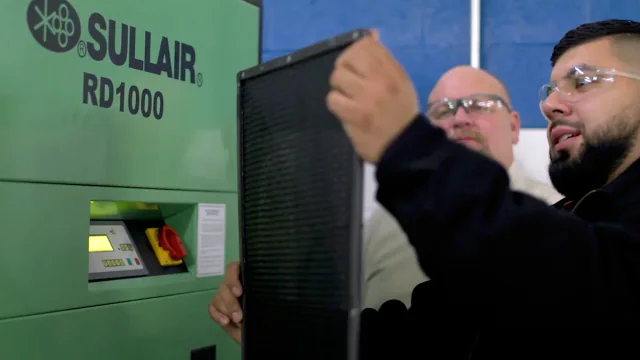
Refrigerated dryers are cost-effective, reliable, and low-maintenance. They're well-suited to facilities where the compressed air distribution system is indoors and the end applications don't require extremely low moisture levels. Brabazon supplies and services refrigerated dryers from leading manufacturers and can size a unit precisely for your system's CFM output and inlet conditions.
One limitation: refrigerated dryers cannot achieve dewpoints below 35°F, making them unsuitable for outdoor applications in cold climates (where lines may still freeze) or processes requiring instrument-quality air with dewpoints below 0°F.
Desiccant Air Dryers: When You Need Ultra-Dry Air
Desiccant (or regenerative) dryers use hygroscopic desiccant material - typically activated alumina or silica gel - to adsorb moisture from compressed air, achieving pressure dewpoints as low as -40°F or even -100°F. They operate in two-tower configurations, with one tower drying while the other regenerates.
Desiccant dryers are required in applications including outdoor compressed air systems in cold climates (to prevent freezing), instrument air for process control systems, pharmaceutical and food-grade air applications requiring extremely low moisture content, and any process where water contamination would cause product failure or safety hazards.
They consume more energy than refrigerated dryers (either through purge air consumption in heatless designs, or through heater operation in heated-purge designs), so proper sizing and selecting the right regeneration method is critical for managing operating costs.
Filtration: The Essential Complement to Drying
Dryers remove moisture, but compressed air also carries oil aerosols, particulates, and oil vapor - each of which requires separate filtration stages. A complete compressed air treatment system typically includes a particulate filter, a coalescing filter (to remove liquid oil and water aerosols), the dryer, and in some applications, an activated carbon filter to remove oil vapor down to 0.003 ppm.
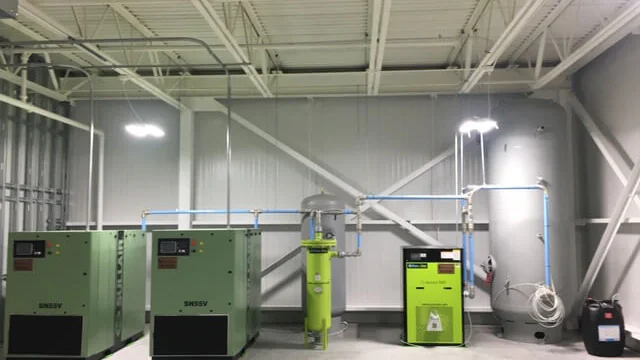
Brabazon designs and installs complete air treatment systems matched to your application's air quality requirements. Our technicians can audit your existing system, identify treatment gaps, and recommend the combination of dryers and filters that will reliably meet your air quality specifications - at the lowest operating cost.
Get Dryer Recommendations
Not Sure Which Dryer Your System Needs?
Brabazon's compressed air specialists serve industrial facilities across Wisconsin, Illinois, Minnesota, and Missouri. Whether you need a refrigerated dryer for a general manufacturing application or a desiccant system for critical process air, our team can size the right equipment, install it correctly, and maintain it with preventive service programs that keep your air dry and your operation running.
Call 800.825.3222 or contact us online to schedule a compressed air quality assessment at your facility.
Written by
Heath Brabazon
President