
Selecting the appropriate compressed air dryer is essential for optimal industrial facility operations. These dryers are crucial in ensuring clean, dry air by eliminating moisture. In this guide, Brabazon, a frontrunner in industrial compressed air solutions in the Midwest, provides a concise overview of the significance of these dryers, critical considerations for selection, and the premium range we offer. Dive in to make a more informed decision for your facility.
In this article
Understanding Compressed Air Dryers
A compressed air dryer is an integral component of many industrial processes. Moisture that builds up in industrial air compressor systems can cause significant issues, such as rust, corrosion, or even bacterial growth. These concerns can drastically reduce the lifespan of your equipment and lead to operational inefficiencies. A compressed air dryer steps in to address this challenge, ensuring that the air produced by your compressor remains free of moisture and particulate contaminants, guaranteeing clean, dry air for your facility.
How to Select an Air Dryer
Choosing the right compressed air dryer for your facility is crucial to ensure seamless operations. To select the ideal dryer, it should align with the air production rate of your compressor. This requires you to take into account several considerations:
- Pressure Dew Point: This measures the temperature at which air becomes saturated, causing moisture to form. Determining your ideal pressure dew point helps in picking a dryer that prevents condensation.
- Inlet Air Pressure and Temperature: Understand the incoming air’s conditions to ensure the dryer works optimally.
- Environmental Conditions: The location and conditions in which your air dryer will operate play a significant role. Whether it’s a high-humidity environment or one with fluctuating temperatures, your dryer needs to handle these variables.
- Ambient Air and Water Temperatures: These can impact the efficiency and performance of your air dryer, especially in processes where precise conditions are crucial.
- Maximum Air Flow (scfm): This represents the volume of air your facility processes. Ensuring your air dryer can handle this volume is essential for efficient operations.
For those looking to delve deeper into sizing considerations, read “How to Properly Size a Compressed Air Dryer,” which provides further insights. And if any of these metrics seem daunting, the team at Brabazon is always on hand to assist. Reach out to us for assistance.
Brabazon’s Range of Compressed Air Dryers
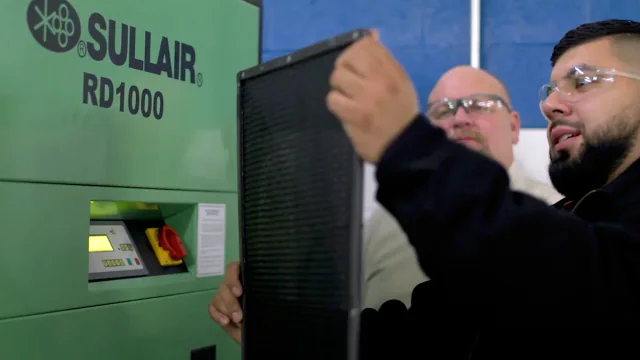
Your operations deserve nothing but the best, and that’s why Brabazon boasts an expansive compressed air dryer selection. We’re proud to feature lines from esteemed brands such as Sullair and Pure-Aire. Whether you’re in the market for refrigerated cycling or non-cycling options or perhaps you’re considering heatless regenerative variations, our selection ensures that you find the perfect fit for your facility’s unique demands.
Step-by-Step Guide to Sizing a Compressed Air Dryer
Selecting the correct dryer for your facility involves more than just matching it to your compressor's nameplate capacity. Here's the process Brabazon's engineers follow when specifying a dryer for Midwest industrial facilities:
Step 1: Determine your actual compressed air flow (CFM)
Your dryer must be sized for the maximum CFM output of your compressor, not your average demand. Using a dryer undersized for peak flow will result in elevated dew points and moisture breakthrough.
Step 2: Identify your required pressure dew point (PDP)
General manufacturing: +35°F to +50°F PDP (refrigerated dryer). Outdoor piping in Midwest winters: 0°F PDP or lower (heated desiccant). Food, pharma, electronics: -40°F PDP (desiccant).
Step 3: Account for correction factors
Standard dryer ratings assume 100°F inlet temperature, 100 PSI operating pressure, and 100°F ambient temperature. If your conditions differ - which they almost always do - you must apply correction factors that effectively derate the dryer's rated capacity.
Step 4: Choose the right dryer technology
Refrigerated cycling or non-cycling for general use. Desiccant (heated or heatless) for critical applications. Membrane for point-of-use in low-flow applications.
Step 5: Consider total cost of ownership
Refrigerated dryers have low operating costs but limited dew point capability. Desiccant dryers achieve deep dew points but consume purge air (heatless) or electrical energy (heated) for regeneration. Brabazon helps you calculate the full 10-year cost of ownership so you make the decision that's best for your budget - not just the lowest upfront price.
Bringing It All Together: Your Trusted Partner in Compressed Air Solutions
Compressed Air Dryer Selection FAQ
What size dryer do I need for my 50 HP Sullair compressor?
A standard 50 HP rotary screw compressor produces approximately 200 to 230 CFM at 125 PSI. You'd typically need a dryer rated for at least 250 CFM at your facility's actual inlet conditions. Brabazon can verify the correct size after accounting for temperature and pressure correction factors specific to your installation.
Can I use one dryer for multiple compressors?
Yes, in many cases a single larger dryer is more efficient and cost-effective than individual dryers for each compressor. The dryer must be sized for the combined maximum output of all compressors running simultaneously. Brabazon designs these systems regularly across the Midwest.
My current dryer is keeping up, but I'm seeing rust in my lines. Why?
This typically means the dryer's actual performance has degraded - often due to a dirty heat exchanger, a failed condensate drain, or a refrigerant leak. It may also be undersized for your current air usage if production has grown since original installation. Brabazon offers dryer service and system assessments to diagnose the root cause quickly.
How do I know if a desiccant dryer is worth the extra cost?
If moisture damage to downstream equipment or products costs more than the operating cost difference between a refrigerated and desiccant dryer, desiccant is worth it. Brabazon can prepare a cost-benefit analysis for your specific situation. Contact us at any of our 14 Midwest locations.
Written by
Heath Brabazon
President