Nitrogen is the second most widely used industrial gas after compressed air - used in food packaging, metal fabrication, electronics manufacturing, pharmaceutical production, tire inflation, fire suppression, and dozens of other applications. Most facilities that use nitrogen today receive it in cylinders or bulk liquid dewars delivered by a gas supplier. On-site nitrogen generation offers an alternative: produce your own nitrogen from compressed air, on demand, at a fraction of the per-unit cost of delivered gas. This guide explains how on-site nitrogen generation works, what it costs, and how to determine whether it makes financial sense for your operation.
In this article
How On-Site Nitrogen Generation Works
On-site nitrogen generators do not create nitrogen - nitrogen makes up 78% of the air we breathe. They separate nitrogen from the other components of compressed air (primarily oxygen, argon, and water vapor) to produce a concentrated nitrogen stream. Two technologies accomplish this separation: Pressure Swing Adsorption (PSA) and membrane separation.
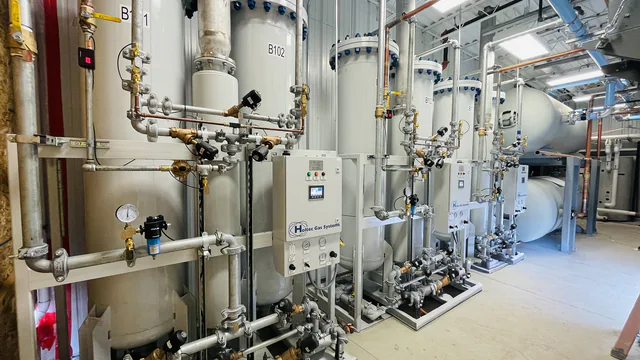
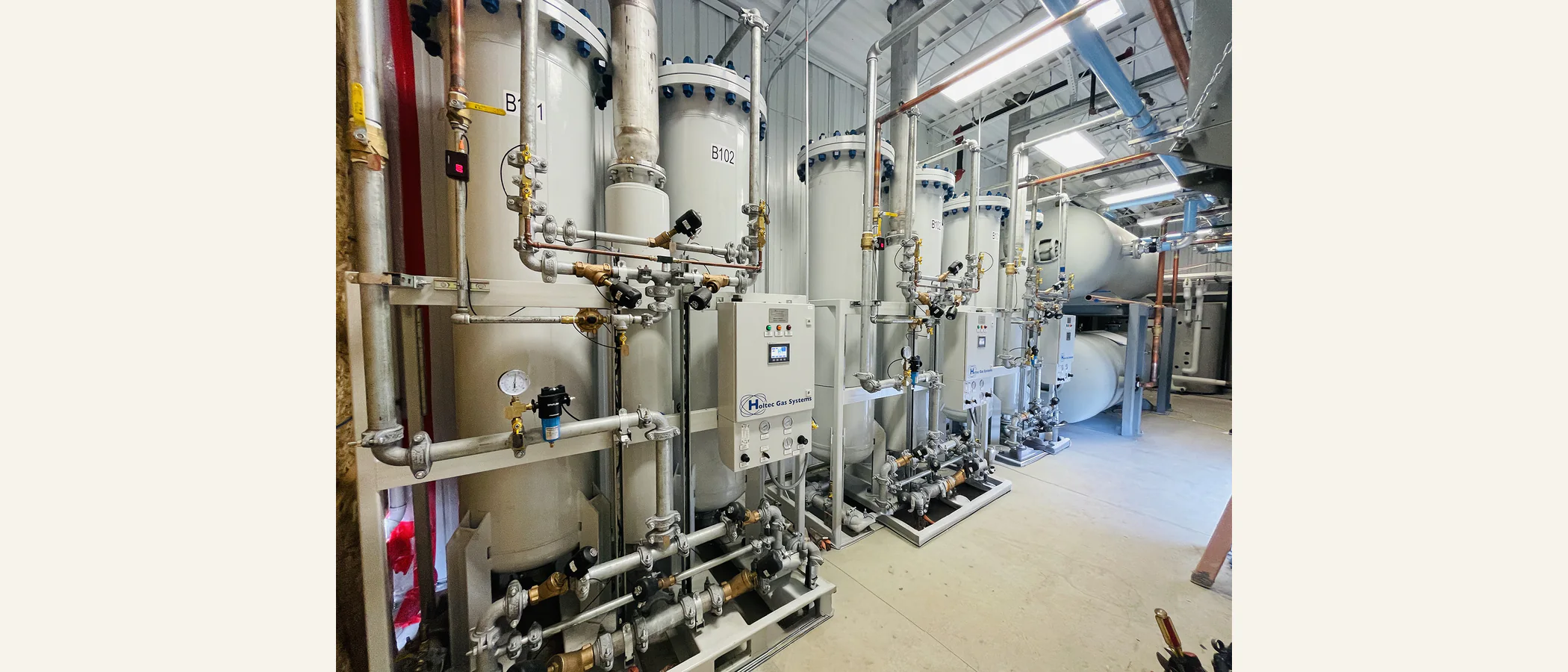
PSA Nitrogen Generators. PSA systems use carbon molecular sieve (CMS) media in two alternating vessels. Compressed air enters the first vessel, where oxygen molecules are selectively adsorbed by the CMS media, allowing nitrogen to pass through. While the first vessel is producing nitrogen, the second vessel depressurizes, releasing the captured oxygen and regenerating the media. The vessels alternate continuously, producing a steady nitrogen stream. PSA systems can achieve purity levels of 95 to 99.999%, making them suitable for applications requiring very high purity nitrogen.
Membrane Nitrogen Generators. Membrane systems use bundles of hollow fiber membranes that selectively permeate oxygen, water vapor, and CO₂ faster than nitrogen. Compressed air enters the fiber bundle; oxygen and moisture permeate through the membrane walls and are vented; nitrogen-enriched air exits the other end as the product stream. Membrane systems are simpler, have no moving parts in the separation unit itself, and work well for applications requiring 95 to 98% purity. They are less efficient than PSA at very high purity levels but are very reliable and low-maintenance.
What Purity Level Do You Need?
Nitrogen purity requirements vary significantly by application, and the required purity level is the most important variable in system selection and cost:
95 to 97% purity:
Tire inflation, fire suppression, some welding blanket applications, and purging pipelines97 to 99% purity:
Modified atmosphere packaging (MAP) for food, laser cutting assist gas, general inerting99 to 99.5% purity:
Metal heat treating, electronics wave soldering, pharmaceutical inerting99.9 to 99.999% purity:
Semiconductor manufacturing, analytical instrumentation, specialty chemical applications
Specify only the purity you actually need. Higher purity requirements reduce the flow rate from a given generator and increase energy consumption per unit of nitrogen produced. Overstating purity requirements significantly increases system cost and operating expense.
The Economics of On-Site Generation vs. Delivered Gas
The financial case for on-site nitrogen generation is straightforward once you have current usage and cost data. On-site generation produces nitrogen at a cost of roughly $0.02-$0.10 per hundred cubic feet (CCF) of nitrogen, depending on your electricity rate and the purity you require. Delivered nitrogen in cylinders typically costs $1.50-$4.00 per CCF - delivered bulk liquid costs somewhat less at scale, but still typically $0.30-$1.00 per CCF plus rental fees for storage equipment and delivery charges.
For facilities consuming more than 5 to 10 cylinders per week (or equivalent bulk liquid volume), on-site generation almost always delivers a payback period of two to four years, with significant ongoing savings for the 15 to 20 year life of the equipment. Facilities with higher consumption typically see payback in one to two years.
Additional economic factors in favor of on-site generation: no more gas delivery scheduling, no cylinder handling and safety issues, no risk of running out of nitrogen mid-shift, and elimination of cylinder rental and delivery fees.
What You Need to Install an On-Site Nitrogen Generator
Nitrogen generators require a clean, dry compressed air supply as their feed gas. This means:
- An air compressor sized to supply the generator's required input volume (nitrogen generators require 3 to 10 CFM of compressed air for every 1 CFM of nitrogen produced, depending on purity)
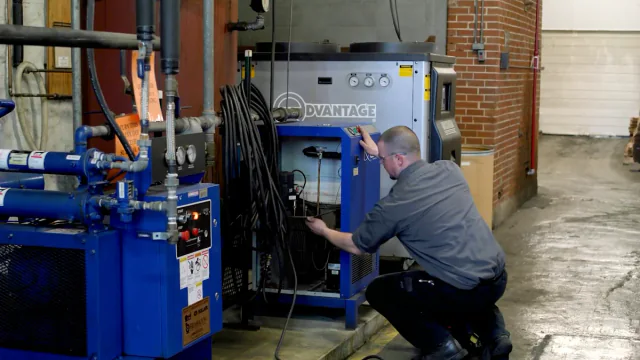
- Compressed air dryer and filtration upstream of the generator (moisture and particulates damage the membrane or CMS media)
- Storage buffer tank for nitrogen output
- Distribution piping to points of use
If you already have a compressed air system with sufficient capacity, adding a nitrogen generator may be straightforward. If your compressed air system is already running at or near capacity, you may need to add compressor capacity to support the nitrogen generator's air demand - this factors into the ROI calculation.
Brabazon Nitrogen Generation Systems
Brabazon supplies, installs, and services on-site nitrogen generation systems across the Midwest. Our team will evaluate your current nitrogen usage (volume, purity, and application), your existing compressed air system, and your current delivered gas costs to produce an honest ROI analysis comparing on-site generation to your current supply method. We supply both PSA and membrane systems and will specify the technology that fits your purity requirements and usage profile. If on-site generation does not make economic sense for your situation, we will tell you that too.
Related Resources
- Industrial Air Compressors - the compressor feeding your nitrogen generator matters - browse Brabazon's lineup
- System Installation Services - Brabazon installs nitrogen generation systems and supporting compressed air equipment
- Oil-Free vs. Oil-Lubricated Air Compressors - nitrogen generation typically requires oil-free upstream air
Get a Nitrogen System Quote