If your facility's compressed air demand fluctuates - by shift, by season, or by production schedule - a variable speed drive (VSD) air compressor is almost certainly worth a serious look. VSD technology has been the biggest efficiency advancement in industrial compressed air in decades, and yet many Midwest manufacturing facilities are still running fixed-speed compressors that cycle on and off, wasting energy every hour they operate. This guide explains how VSD compressors work, when they make economic sense, and what to watch for when evaluating one.
In this article
How a Fixed-Speed Compressor Wastes Energy
A traditional fixed-speed rotary screw compressor has one operating mode: full speed. When demand drops below full output, the compressor enters an "unloaded" state - the motor keeps running at full speed, but the compressor is not making air. It is burning approximately 15 to 25% of full-load power to do nothing productive. Then when pressure drops and demand returns, it reloads and goes back to full output.
In plants where demand varies significantly, the compressor spends a substantial portion of its operating hours in this unloaded, inefficient state. The energy cost is real; the production benefit is zero.
How VSD Changes the Equation
A variable speed drive compressor uses a frequency inverter to vary the speed of the compressor motor in real time. When demand is low, the motor slows down and delivers less air. When demand rises, the motor speeds up. Output tracks demand continuously, within a range (typically 20 to 100% of rated capacity).
The energy savings are significant because power consumption in a rotary screw compressor does not scale linearly with speed - it scales more favorably. Running at 70% speed uses considerably less than 70% of full-load power. In most variable-demand applications, VSD compressors deliver 20 to 35% energy savings compared to an equivalent fixed-speed unit.
When VSD Makes the Most Financial Sense
VSD compressors cost more upfront than fixed-speed units - typically 20 to 30% more for equivalent capacity. That premium needs to pay back through energy savings. The calculation works in your favor when:
- Your demand varies significantly over the course of a shift or day (more than 30 to 40% variation)
- You run multiple shifts with very different air demand profiles
- Your facility has seasonal demand swings - common in food processing, automotive, and HVAC-adjacent manufacturing
- You are replacing an aging fixed-speed unit that is already inefficient
- Your electricity rate is above $0.08/kWh (typical for Illinois, Wisconsin, and surrounding Midwest states)
The payback period for a VSD upgrade in these conditions is typically two to four years, with the compressor providing savings for 15 to 20 years of service life.
When Fixed-Speed May Still Be the Right Choice
VSD is not always the answer. If your air demand is relatively constant - a facility that runs a single shift at consistent production rates with minimal variation - the premium for a VSD unit may not pay back quickly enough to justify the cost. Fixed-speed compressors are simpler mechanically, have lower maintenance costs in some configurations, and are fully adequate for steady-load applications.
The right answer depends on a data-logged analysis of your actual demand profile, not a general rule. Brabazon performs demand analysis as part of our compressed air audits, which gives you the actual numbers you need to make the right capital decision.
Sullair VSD Compressors: What Brabazon Sells and Services
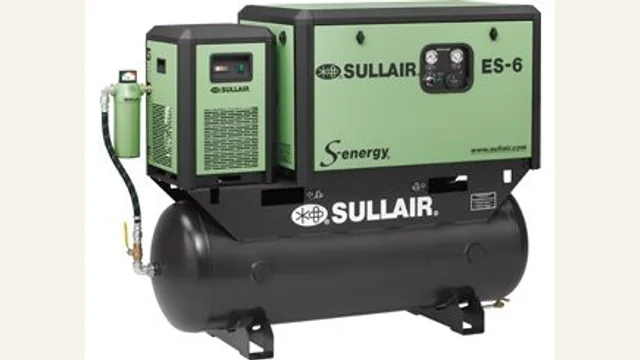
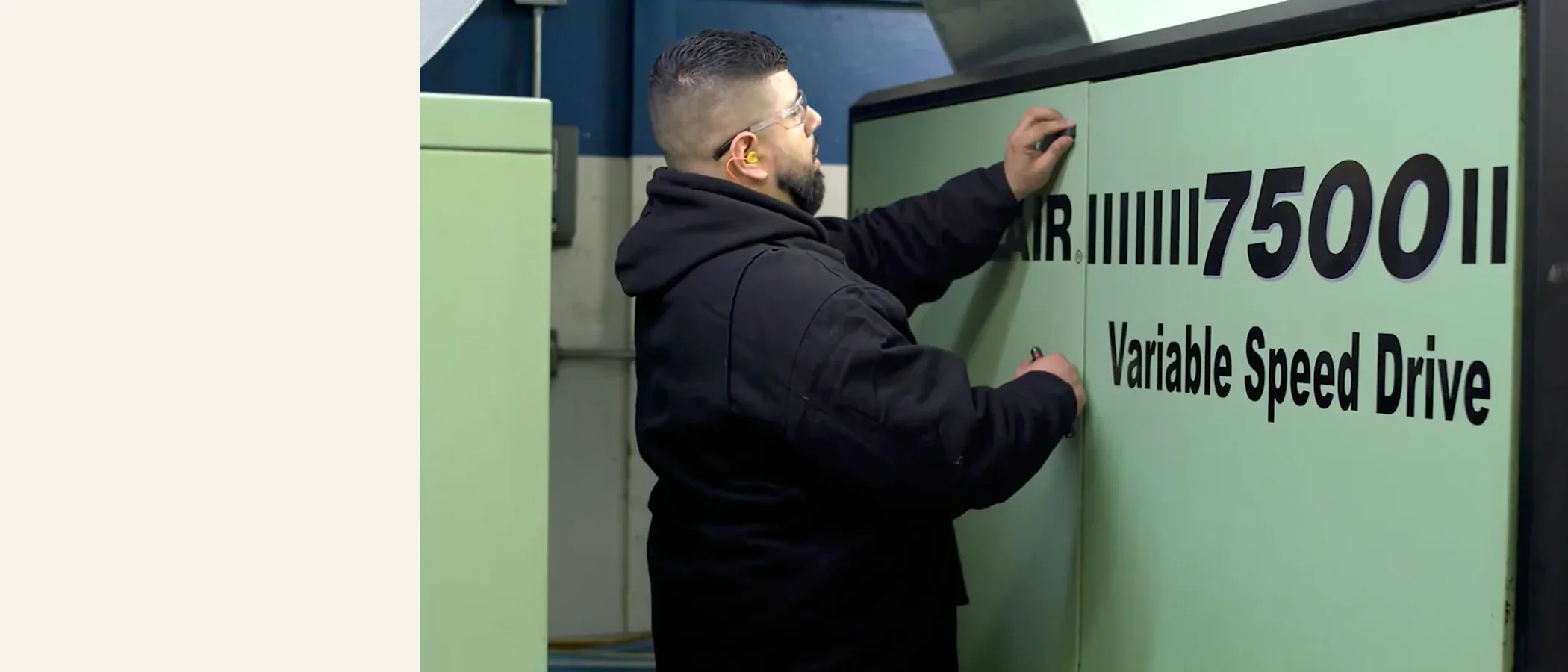
As an authorized Sullair dealer with factory-certified technicians, Brabazon supplies and supports Sullair's VSD lineup across the Midwest. Sullair's variable speed rotary screw compressors are designed for industrial duty-cycle applications - the kind of demand variation common in metal fabrication, food processing, plastics, and automotive plants throughout Illinois, Wisconsin, Minnesota, Indiana, and Missouri.
Sullair VSD units include integrated pressure and temperature monitoring, remote diagnostics capability, and are designed for the Midwest's temperature extremes - both the -20°F winter startups and the 95°F summer ambient conditions that stress compressor cooling systems. Our technicians are factory-trained on Sullair systems and carry parts inventory to minimize downtime when service is needed.
Combining VSD with a Fixed-Speed Base Load Unit
Many facilities find the optimal solution is not a single VSD compressor but a combination: a fixed-speed base-load unit that runs continuously to meet minimum demand, plus a VSD trim unit that handles the variation above that baseline. This configuration delivers both the reliability of fixed-speed operation and the efficiency of VSD for the variable portion of demand. It also provides built-in redundancy - if one unit goes down, the other can continue to supply air at reduced capacity.
Designing this type of system correctly requires load profile data and an understanding of your production schedule. Brabazon's team has designed and installed multi-compressor systems of this type for manufacturing facilities across our service territory.
Related Resources
- Industrial Air Compressors - browse Brabazon's full compressor lineup including VSD models
- Compressor Installations - Brabazon handles sizing, delivery, and commissioning of new VSD equipment
- How to Reduce Your Compressed Air Energy Costs - broader strategies beyond VSD compressors
Talk to a VSD Specialist