Portable Diesel Air Compressors Sized to Your Jobsite Tools
The right cfm for your tools, ready to buy or rent across the 185, 375, and 750 workhorse classes, dispatched from 7 branches serving 14 metro areas.
What size towable diesel compressor do I need for my jobsite tools?
A portable diesel air compressor, also called a towable air compressor, is a trailer-mounted diesel-powered unit that supplies compressed air to pneumatic tools and equipment anywhere on a jobsite without electrical hookups. Total the cfm of the tools running at once and match it to the three workhorse classes: a 185 runs two mid-size tools like breakers, a 375 covers three to four tools or a single blast hose, and a 750 handles two blast hoses or large drills. The Sullair 375 series is the workhorse of the three because one blast nozzle at 250 to 400 cfm consumes a 375 almost by itself.
Portable diesel and towable air compressors we stock
Family owned since 1978, we sell, rent, and service the towable diesel range for construction and mining contractors across the Midwest. Real photos and headline specs are below; every model links to its full spec page.
-
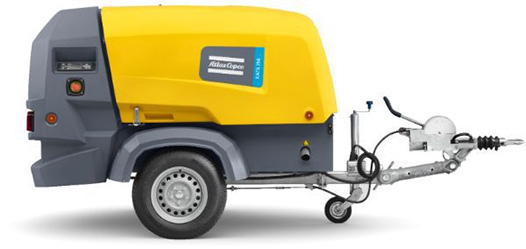
Atlas Copco XATS 250
- Free air delivery
- 189 to 250 CFM
- Pressure
- 100 to 150 PSI adjustable (PACE)
- Engine
- Kubota Tier 4 Final diesel
- Weight
- 2,560 lbs, tows behind a pickup
-
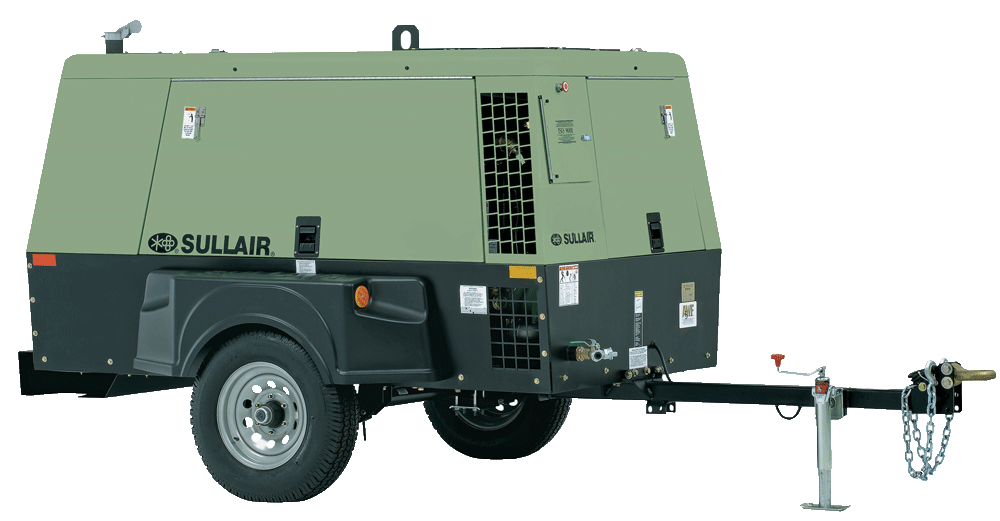
Sullair 375 Series
- Free air delivery
- 375 to 425 CFM
- Pressure
- 150 to 200 PSI
- Air end
- Sullair 16-Series rotary screw
- Engine
- Tier 4 Final Caterpillar or Perkins
-
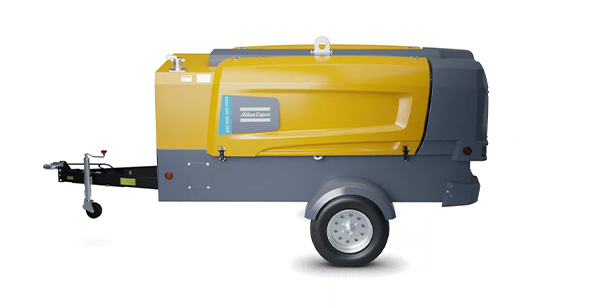
Atlas Copco XAS 400-150 PACE CD
- Free air delivery
- up to 410 CFM
- Pressure
- 100 and 150 PSI presets (PACE)
- Engine
- John Deere 4045EWL Tier 4 Final
- Weight
- 4,700 lbs
-
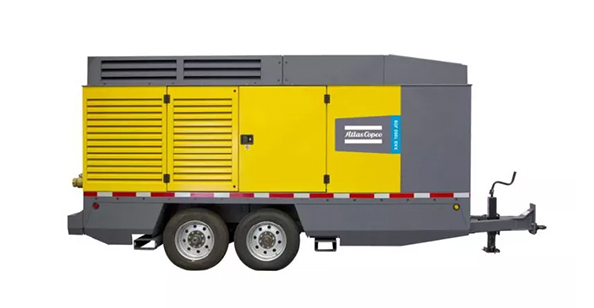
Atlas Copco XAS 1800 JD
- Free air delivery
- 1400 to 1800 CFM
- Pressure
- 72.5 to 200 PSI adjustable
- Engine
- 540 HP John Deere Tier 4 Final
- Controls
- Smart Air Xc4004 with FuelXpert
-
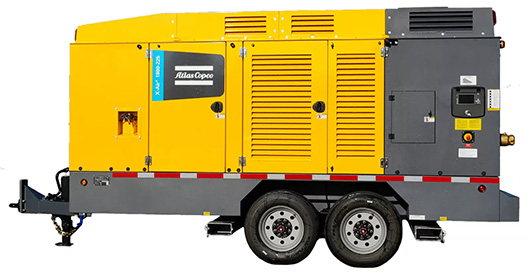
Atlas Copco X-Air+ 1800-225
- Free air delivery
- 1200 to 1800 CFM
- Pressure
- 58 to 225 PSI adjustable (PACE)
- Engine
- 536 HP Caterpillar C13B Tier 4 Final
- Air treatment
- Onboard aftercooler and water separator
Tool CFM quick reference for sizing a towable
Sizing for construction and mining work starts with the tools. The figures below are honest typical draws for common pneumatic tools, not machine ratings: actual demand varies by make, hose length, and duty cycle, so use them for rough sizing and confirm with the CFM calculator or an engineer. Add up everything that runs at once, then add roughly 25 percent headroom.
| Tool (typical draw) | Typical CFM at 90 to 100 psi |
|---|---|
| 90 lb paving breaker | about 90 CFM |
| 60 lb clay digger or tamper | about 40 to 55 CFM |
| Rock drill (jackleg or sinker) | about 100 to 200 CFM |
| Sandblasting, number 6 nozzle | about 250 CFM |
| Sandblasting, number 8 nozzle | about 400 CFM |
| 1 inch impact wrench | about 10 CFM |
| Pneumatic pick or chipping hammer | about 30 to 40 CFM |
Most of this work is mining and construction air. For the sizing math behind it, our guides on how much CFM you need and single stage vs two stage compressors walk the decisions.
The three classes, by tool load
| Class | What it runs | Typical work |
|---|---|---|
| 185 cfm | Two 90 lb breakers, or tampers and small tools | Utility, road repair, light demolition |
| 375 to 425 cfm | One blast hose (number 6 to 8 nozzle), or 3 to 4 tools | Abrasive blasting, drilling, bridge work |
| 750 cfm | Two blast hoses, rock drills, pipeline tools | Quarries, pipelines, industrial coating |
Portable diesel models we stock and service
-
Sullair 185 Series
- Flow
- 185 cfm at 100 psi
- Runs
- 2 mid-size air tools
- Tow
- Half-ton truck
- Best for
- Utility crews, breakers, small blast pots
-
Sullair 375 Series
- Flow
- 375 to 425 cfm
- Runs
- 3 to 4 tools or one blast hose
- Tow
- Three-quarter-ton and up
- Best for
- Blasting, drilling, general construction
-
Sullair 750H Series
- Flow
- 750 cfm, high pressure options
- Runs
- Two blast hoses or large drills
- Tow
- Heavy-duty tow vehicle
- Best for
- Pipelines, quarries, industrial blasting
-
Sullair 900H Series
- Flow
- 900 cfm
- Runs
- Multiple high-demand tools
- Tow
- Heavy-duty tow vehicle
- Best for
- Large sites needing one big air source
-
Sullair 1600H Series
- Flow
- 1,600 cfm
- Runs
- Drill rigs and multi-crew sites
- Tow
- Heavy-duty tow vehicle
- Best for
- Drilling and the biggest air demands
-
Sullair OFD1550 Oil Free
- Flow
- 1,550 cfm, oil free
- Class
- ISO 8573-1 Class 0
- Tow
- Heavy-duty tow vehicle
- Best for
- Temporary Class 0 process air
Support behind the machine
- Field repair, PM programs, and airend rebuilds through our service teams
- Bridge a peak or a breakdown with air compressor rentals
- Parts counters and dispatch from 7 branches serving 14 metro areas, including Milwaukee, Green Bay, and Chicago
- Common on mining and construction and manufacturing sites; need shop or plant air instead? See rotary screw compressors
Towable compressor questions, answered first
How many CFM does each of my jobsite tools need?
Add up the rated cfm of the tools that run at the same time: a 90 lb paving breaker draws about 90 cfm, a rock drill 100 to 200 cfm, and a blast nozzle is the big one, roughly 250 cfm through a number 6 nozzle and 400 cfm through a number 8. One blast hose alone puts you in the 375 class; two hoses or a large drill push you to 750 and up.
Will a 185 tow behind my pickup, and what about the bigger classes?
Yes, a 185 class weighs roughly 2,500 lb and tows behind a properly equipped half-ton pickup. The 375 class runs 4,500 to 6,000 lb and wants a three-quarter-ton or larger, and 750 and up should be moved with a heavy-duty truck rated for the trailer weight. Check the trailer weight of the specific model against the tow rating of your vehicle before dispatch day.
What does Tier 4 Final mean for the diesel on my site?
Tier 4 Final is the current EPA emission standard for off-road diesels, and current Sullair towables meet it using diesel exhaust fluid (DEF) or diesel particulate filters depending on engine size. Practically it means you keep DEF on site for most models and let regeneration cycles finish, and it is why many government and refinery jobs now spec Tier 4 machines only.
Do I really need 100 psi, or should I spec a high pressure model?
Most construction tools and blast pots are designed for 100 to 125 psi, so a standard-pressure machine covers them. Spec the H or HH high-pressure versions when the work is drilling, pipeline testing, or fiber blowing that genuinely calls for 150 to 500 psi, because paying for pressure you never use burns fuel on every shift.
Get a jobsite sizing recommendation from an engineer
Tell us the tools you need to run and an engineer will match the right class, then quote sale or rental. Compressor down on the jobsite? We answer 24/7.
Request a Quote or Book an Air Audit
Request availability and pricing for your class size, or call 800.825.3222 and describe the tools you need to run.
Request a Quote on a portable diesel air compressor
Request received. If you need someone now, call 800.825.3222.
Our team will follow up using the contact details you provided.
Please fill in all required fields (name, company, email, phone, preferred contact method, ZIP, and city), or call 800.825.3222.