Oil-free compressors
Class 0 oil-free machines for cleanroom, molding, and contact air in medical device manufacturing.
Spec Class 0 oil-free air
Industry: Medical devices
Medical Device Air Spec Plate
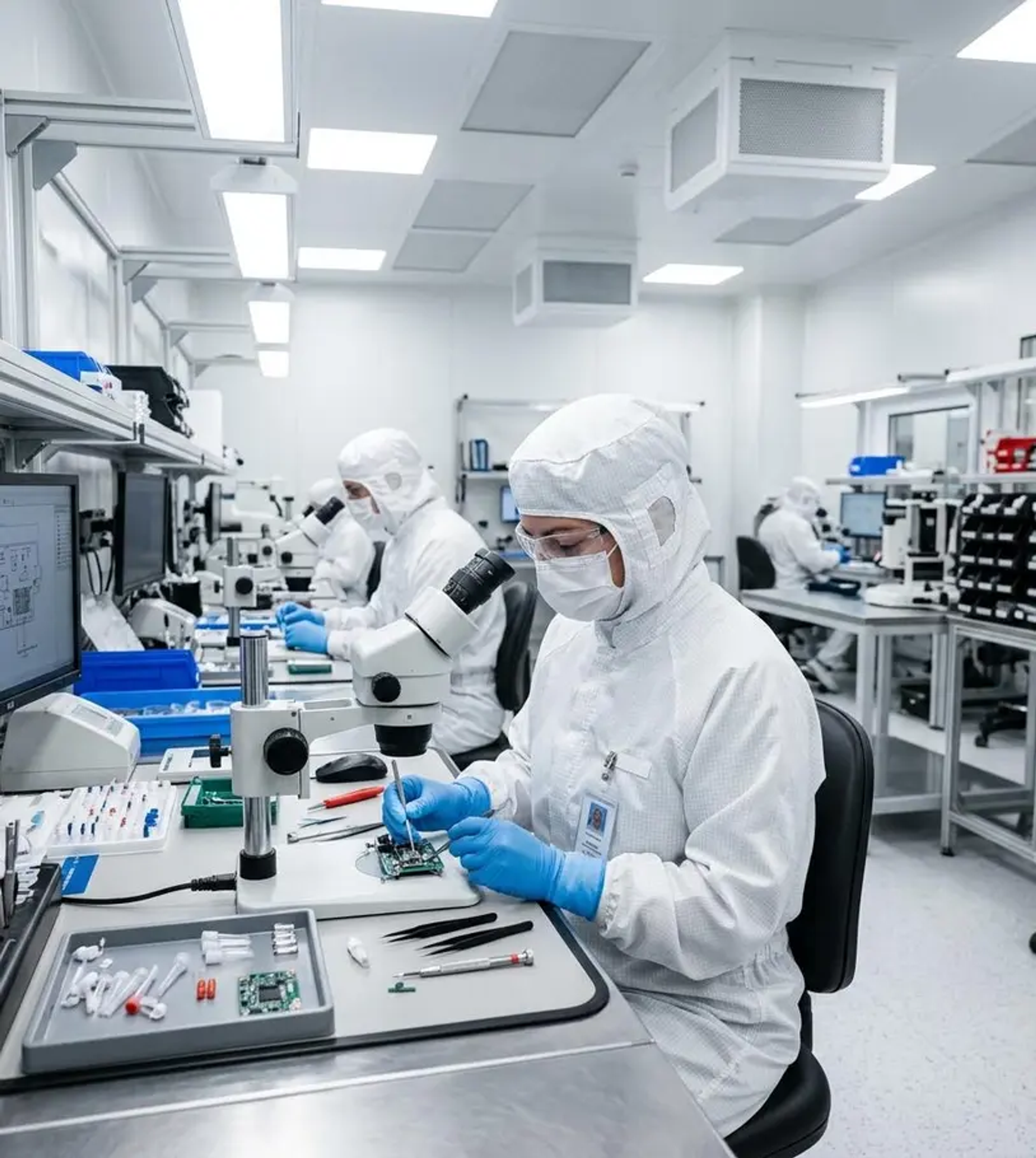
Medical device manufacturing runs on air that touches device components or enters a controlled environment, so the specification is oil-free to ISO 8573-1 Class 0, dried to a stable dew point, and filtered to match the ISO 14644 cleanroom class it serves. That air molds device components, drives assembly and fixturing, runs leak and flow testing, and supports packaging in controlled environments. The Class 0 supply comes from oil-free compressors so contamination is removed at the source, and the drying and filtration are matched to the point of use. The ISO 13485 quality system and any validation stay with the manufacturer; Brabazon supplies equipment and records that make the air quality straightforward to document.
Air that touches a device component or enters a cleanroom is specified oil-free to ISO 8573-1 Class 0, with drying and filtration matched to the ISO 14644 room and point of use. The specification splits by where the air goes.
Air quality split by point of use
Cleanroom and contact air: Oil-free ISO 8573-1 Class 0 from oil-free compressors, dried and filtered to match the ISO 14644 room, with a sterile-grade final filter at the point of use.
Molding and test air: Class 0 supply with a stable dew point so molded surfaces stay clean and leak and flow test readings are repeatable, buffered by a correctly sized receiver.
Documentation: Equipment specifications and maintenance records that support your ISO 13485 air quality documentation. Brabazon supplies and services the equipment; the manufacturer owns the validation.
Run the numbers yourself
See our pharmaceutical and medical page and the electronics page for related Class 0 and cleanroom air guidance.
Oil-free air for mold actuation, part ejection, and blow-off on injection molding of device components where surface cleanliness is critical.
Class 0 oil-free air feeding tools, actuators, and equipment inside ISO 14644 controlled environments without adding hydrocarbon contamination.
Clean, dry air drives pneumatic assembly stations, presses, and fixtures that join and align small device components repeatably.
Stable, dry test air at controlled pressure so leak and flow test results are repeatable and pass or fail decisions are trustworthy.
Clean air for form-fill-seal and tray-seal packaging of sterile devices where product-contact air must not add contamination.
Cleanroom-compatible vacuum for pick-and-place, fixturing, and degassing of small precision device parts.
Dry, oil-free ionized blow-off clears particulate from parts and packaging ahead of inspection and sealing.
Equipment specifications and maintenance records that support the air quality documentation your ISO 13485 quality system requires.
Four disciplines keep a medical device air system out of the contamination and validation risk column.
Air that contacts device components or enters a cleanroom is specified oil-free to ISO 8573-1 Class 0, meaning no measurable oil from the compressor. Oil-free compressors remove the contamination risk at the source rather than relying only on downstream filtration to catch oil carryover. That makes the air easier to validate and keeps a single filter failure from putting oil onto a device.
Dew point matters in two ways: condensation ruins cleanliness and moisture skews test air. General cleanroom air is often dried to a 38 F pressure dew point, while critical lines and any run through cool space use desiccant drying to a negative 40 F dew point. The drying and filtration are matched to the ISO 14644 class of the room and the point of use so the air never carries moisture or particulate into a controlled area.
Leak and flow testing decides whether an assembled device ships. Test air has to hold a stable pressure and a consistent dew point, because pressure swings and moisture change the reading. A correctly sized receiver buffers the demand and a dryer holds the dew point steady, so the test measures the device and not the utility system behind it.
An ISO 13485 quality system and its validation belong to the device manufacturer. What Brabazon provides is equipment configured to a defined air quality target plus the specifications and maintenance records that make documenting that air quality straightforward. We do not certify the manufacturer or perform the validation; we supply and service the equipment that supports it.
For a medical device plant, the package we configure most pairs oil-free rotary compressors supplying ISO 8573-1 Class 0 air with an air dryer holding a stable dew point and a filtration train that finishes with a sterile-grade filter at the point of use. General cleanroom air is dried to a 38 F dew point, while critical molding and test lines use desiccant drying to a negative 40 F dew point. An N+1 configuration is available where a compressor loss cannot be allowed to stop production. See the oil-free compressor page, the air dryers page, and the dryers and filters page for equipment details.
Typical project: Medical devices
A common scenario in this industry is a device manufacturer expanding into the Minnesota medtech corridor that needs Class 0 air across molding, assembly, and leak test without contaminating parts or skewing test readings. A typical project starts when the existing supply relies on filtration downstream of an oil-lubricated compressor, so any filter fault risks putting oil on a molded component, and the test line pressure swings enough to affect leak-test pass and fail decisions. Brabazon-configured equipment solves this with oil-free compressors delivering ISO 8573-1 Class 0 at the source, a correctly sized receiver to hold test-line pressure steady, and drying split so general cleanroom air runs at a 38 F dew point while molding and test lines run desiccant-dried to a negative 40 F dew point. The manufacturer keeps the equipment specifications and maintenance records to support its own ISO 13485 air quality documentation.
Factory-trained technicians dispatch from 7 branches serving 14 metro areas, including our Minneapolis branch serving the Minnesota medtech corridor, with an under 2 hour average emergency response. Find your nearest branch:
Air that contacts device components or enters a cleanroom is typically specified to ISO 8573-1 Class 0 for oil, which means no measurable oil from the compressor, along with a low dew point to prevent condensation and tight particulate filtration. Oil-free compressors provide the Class 0 supply at the source, and the drying and filtration are matched to the ISO 14644 cleanroom class the air serves.
Injection molding of device components uses compressed air for mold actuation, part ejection, and blow-off, and any hydrocarbon carryover can contaminate the part surface and interfere with downstream bonding, coating, or sterilization. Oil-free compressors remove the contamination risk at the source rather than relying only on filtration to catch it, which simplifies validation of the molded component.
Leak and flow testing of assembled devices needs air at a stable, controlled pressure with a consistent dew point so that test results are not skewed by pressure swings or moisture. A properly sized receiver and a dryer holding a steady dew point keep the test air repeatable, which is what makes pass and fail decisions trustworthy on the assembly line.
We supply oil-free compressors, drying, and filtration configured to a defined air quality target and provide the equipment specifications and maintenance records that support your own air quality documentation. The ISO 13485 quality system and any validation belong to the device manufacturer. Brabazon does not certify the manufacturer and does not perform the validation; we provide equipment and service that make documenting the air quality straightforward.
Brabazon serves the Minnesota medical device corridor from our Minneapolis branch, part of 7 branches serving 14 metro areas operating since 1978, and has been the authorized Sullair distributor since 1984. We provide oil-free compressors, air treatment, vacuum, and service across Wisconsin, Illinois, Minnesota, and Missouri, with an under 2 hour average emergency response.
Tell us your cleanroom class, the air quality target for molding, assembly, and test lines, and the documentation your quality system needs. We configure the oil-free supply, drying, and filtration to match, and provide the equipment records that support your air quality documentation.
Press Escape to close. Use the arrow keys to move through results.