Steel and Metals
Full guide to compressed air for metal fabrication: blasting, plasma, and machine shop applications.
See all metal fab applications
Application: Laser cutting
Laser Cutting Air Spec Plate
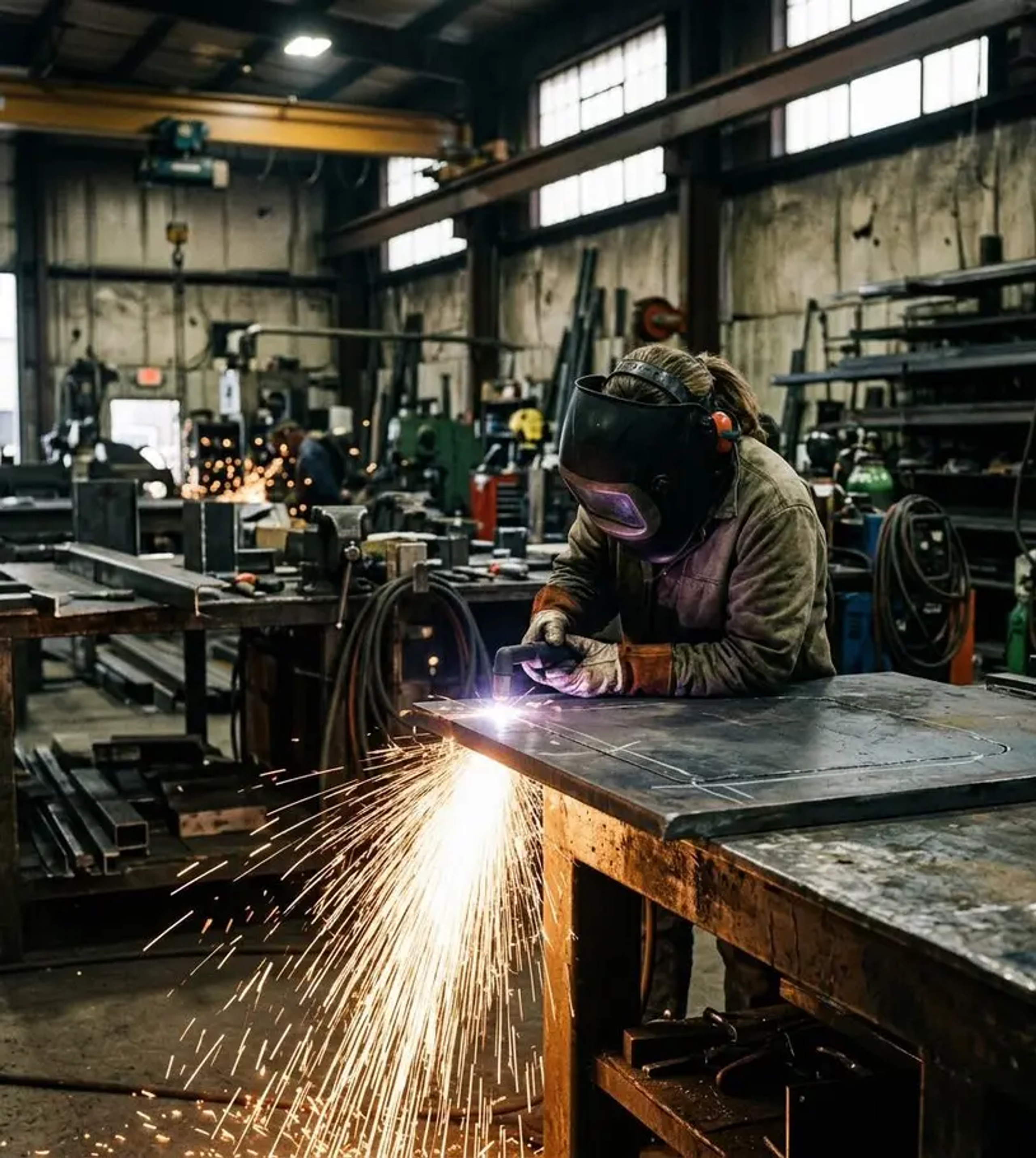
Fiber laser cutting with compressed air assist requires cleaner air than almost any other metalworking application. Oil contamination at the cutting head degrades cut quality and can damage expensive optics. Moisture causes condensation on the lens in humid conditions. The answer is an oil-free supply or a high-quality filtration train on the laser circuit, with desiccant drying for optics protection. Pressure requirements depend on the laser power, material, and thickness.
Air assist requirements depend on the laser power, material, and thickness. The quality requirement is constant: oil-free and dry air at the cutting head. Pressure and flow vary by application.
| Application | Typical pressure at nozzle | Air quality required | Notes |
|---|---|---|---|
| Thin carbon steel air assist (up to 3/8 in) | 15 to 50 psi | ISO 8573-1 Class 1-2 | Oxide scale on edge; acceptable for weld or blast finish |
| Thick carbon steel air assist (over 3/8 in) | 100 to 200 psi | ISO 8573-1 Class 1-2, oil-free | High-power machines only; booster or HP compressor may be needed |
| Thin stainless (typically nitrogen) | 150 to 200 psi nitrogen | N/A for air | Nitrogen preferred for oxide-free edge; air assist not standard |
| Lens purge and optics protection | 1 to 5 psi continuous | ISO 8573-1 Class 1, very dry | Low flow, continuous; critical to prevent spatter on optics |
| Beam path and resonator purge | 0.5 to 2 psi | Ultra-dry, Class 1 | CO2 lasers and sealed beam delivery; fiber laser needs vary |
Confirm pressure and flow with your laser machine manufacturer. High-power machines cutting thick sections may require a dedicated booster compressor or high-pressure supply.
Run the numbers yourself
Air assist on fiber lasers cutting carbon steel where cut edge oxidation is acceptable and cost efficiency is priority.
Low-pressure air assist for thin stainless and aluminum on lower power fiber lasers.
High-pressure air assist on multi-kilowatt fiber lasers cutting thick sections of carbon steel.
Clean dry air purge protecting the focusing lens from spatter and fumes at the cutting head.
Ultra-dry air purging the laser beam path in sealed resonator and beam delivery systems.
Compressed air cooling of the cutting head and nozzle during high-power cutting cycles.
Centralized clean air supply to several laser machines from one compressor room.
Separate quality circuits serving laser machines at Class 1-2 and plasma tables at standard quality from one system.
Four air quality disciplines protect laser optics and maintain cut consistency across the full range of materials and thicknesses.
Oil contamination on the focus lens or nozzle of a fiber laser degrades cut quality, increases kerf width, and can cause lens damage. ISO 8573-1 Class 1 or Class 2 air at the cutting head is the typical specification from laser machine manufacturers. This requires either an oil-free compressor or an oil-injected machine with a high-efficiency coalescing filter bank on the laser circuit.
Moisture in laser assist air can cause condensation on optics during ambient temperature swings, degrade cut quality, and promote corrosion inside sealed beam delivery systems. A desiccant dryer on the laser circuit, or a point-of-use desiccant unit at the machine, is standard on any laser installation where the ambient environment creates condensation risk.
Air assist pressure in fiber laser cutting is not a single number. Thin gauge carbon steel often runs 15 to 30 psi at the nozzle. Thick sections on high-power machines push toward 150 to 200 psi. Check the laser machine manual for the required pressure range at full power. Undersized compressors that cannot hold the specified pressure during a cut cycle cause kerf inconsistency and dross on the cut edge.
Nitrogen assist gas produces cleaner edge quality without oxide on carbon steel and is standard for stainless and aluminum cutting. Compressed air assist is a significant cost savings per cut, at the expense of oxide scale on carbon steel cut edges. The choice depends on your downstream process: weld-ready edges with no scale favor nitrogen; parts going to painting or blasting tolerate air assist at a lower consumable cost.
The setup we specify most for a single fiber laser machine is a dedicated oil-free rotary screw compressor in the 10 to 25 HP range with a desiccant dryer on the laser circuit. In shops with an existing oil-injected compressor, we add a high-efficiency coalescing filter bank and a point-of-use desiccant unit at the laser machine to achieve ISO 8573-1 Class 1-2 without replacing the compressor. For thick-section cutting at pressures above 175 psi, a booster compressor on the laser circuit is the most practical solution. See the oil-free compressor page for Class 0 options and dryers and filters for the circuit treatment options.
Typical project: laser assist gas circuit
A common scenario in this industry is a laser fabrication shop seeing recurring lens damage and inconsistent cut quality on a fiber laser running off the plant shop air system. An inspection often finds no dedicated filtration on the laser circuit: oil aerosols from the oil-injected compressor are reaching the cutting head. A typical project installs a high-efficiency coalescing filter station and a point-of-use desiccant dryer at the laser machine inlet, achieving ISO 8573-1 Class 1 air quality at the head. Lens replacement frequency then falls sharply and cut quality on stainless improves enough to reduce secondary grinding. Brabazon specs and installs the filtration and drying for this kind of laser circuit.
Factory-trained technicians dispatch from 7 branches serving 14 metro areas with an under 2 hour average emergency response. Find your nearest branch:
Yes, for the laser assist gas circuit. Oil contamination on the focus lens or nozzle degrades cut quality and can damage optics. Either a dedicated oil-free compressor or an oil-injected machine with a high-efficiency coalescing filter train providing ISO 8573-1 Class 1 or Class 2 air is the correct specification for laser assist gas.
Fiber laser air assist pressure requirements vary by material, thickness, and laser power. Cutting carbon steel with air assist typically runs 15 to 30 psi for thin gauges up to 150 to 200 psi for thick sections on high-power machines. Check your laser machine manufacturer specification for the exact pressure range.
Nitrogen produces oxide-free cut edges on carbon steel and is required for clean cutting of stainless steel and aluminum. Air assist is significantly cheaper per cut and is acceptable when the cut edge will be welded with weld prep, blasted, or painted without tight tolerance requirements. Most shops run nitrogen on stainless and aluminum and air on carbon steel parts going to paint or blast.
Most fiber laser machine manufacturers specify ISO 8573-1 Class 1 or Class 2 for the assist gas supply. Class 1 sets the most stringent limits on oil content and moisture. A high-efficiency oil-free compressor or an oil-injected machine with a multi-stage coalescing filter train can achieve this at the laser inlet.
Yes, if the compressor has enough CFM for both and the laser circuit runs from a dedicated clean-air branch with a coalescing filter and desiccant dryer. The plasma circuit runs from the same header at standard quality. The separation is done at the header distribution, not by using two separate compressors.
Brabazon supports metal fabrication shops from 7 branches serving 14 metro areas with an under 2 hour average emergency response. We have been the authorized Sullair dealer since 1984 and have experience specifying and installing laser assist gas compressor systems.
Tell us your laser wattage, material mix, thickness range, and current air setup. We spec the air quality, pressure requirement, and compressor configuration.
Press Escape to close. Use the arrow keys to move through results.