Steel and Metals
Full guide to compressed air for metal fabrication: plasma, laser, and machine shop applications.
See all metal fab applications
Application: Abrasive blasting
Sandblasting Air Spec Plate
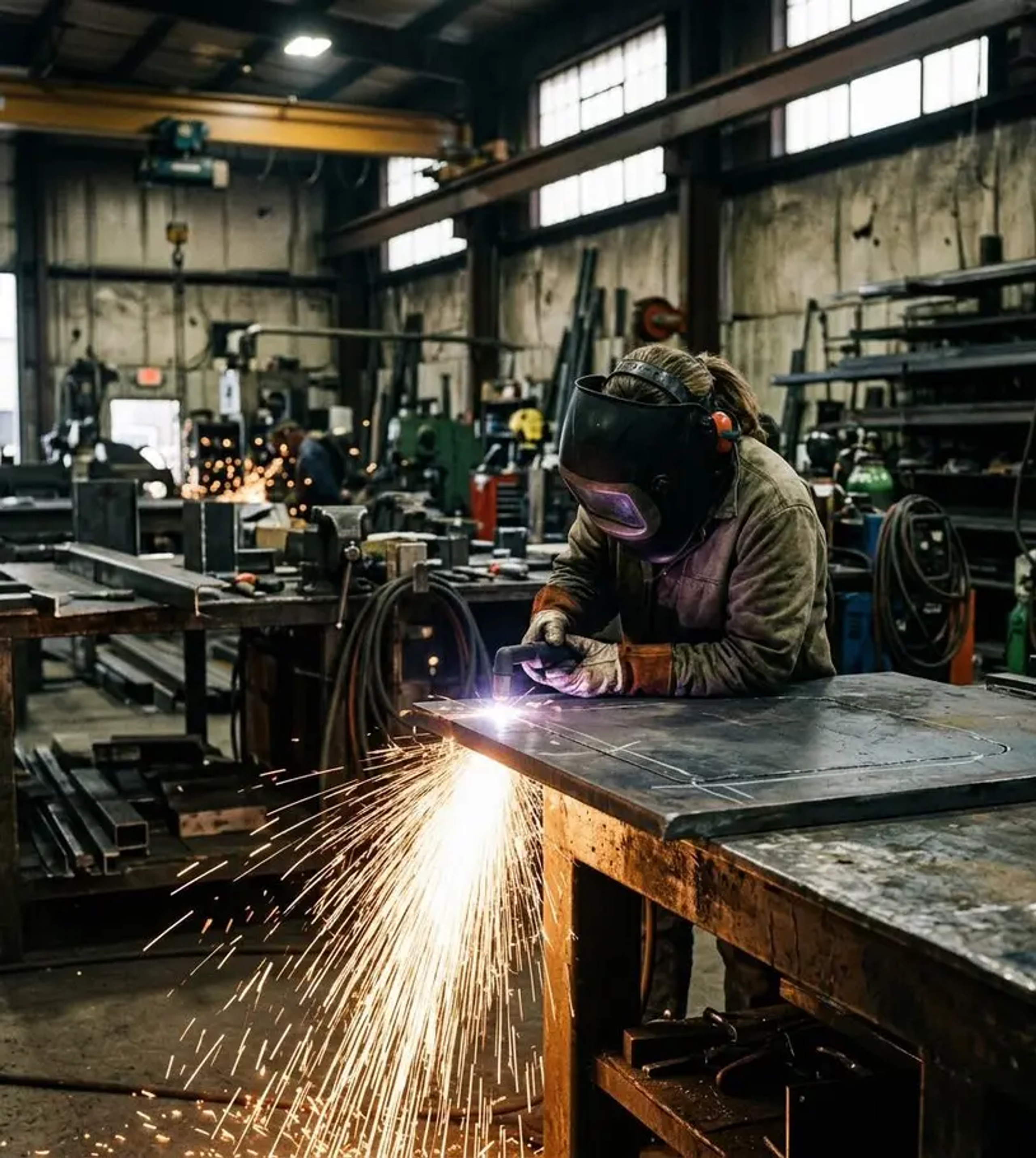
The right size air compressor for sandblasting comes from the nozzle orifice and the number of nozzles running at the same time. Most sizing mistakes happen when someone picks a compressor by horsepower instead of by nozzle CFM at working pressure. The table below gives the nozzle demand and the compressor class that covers it, including hose loss margin.
Use these values as a starting point. Nozzle CFM is measured at the nozzle at working pressure with new media. Add 20 to 25 percent for hose losses and altitude above 3000 ft. Use the CFM calculator to add simultaneous tools.
| Nozzle orifice (approx.) | CFM at 100 psi (at nozzle) | Recommended compressor output | Typical compressor class |
|---|---|---|---|
| 3/16 to 1/4 inch | 25 to 50 CFM | 35 to 65 CFM | 15 to 25 HP rotary screw |
| 5/16 to 3/8 inch | 55 to 95 CFM | 70 to 120 CFM | 30 to 50 HP rotary screw or 185 portable |
| 7/16 to 1/2 inch | 100 to 170 CFM | 130 to 215 CFM | 50 to 75 HP or 185 to 250 portable |
| 9/16 inch and larger | 175 to 300 CFM | 220 to 375 CFM | 75 to 125 HP or 375 class portable |
| Multiple nozzles or large-orifice production | 300 CFM and up | 375 CFM and up | 375 to 750 class portable or 125 HP+ |
| Job type | Typical nozzle range | Compressor class |
|---|---|---|
| Automotive, small parts, hobby | Small orifice (3/16 to 1/4 in) | 15 to 25 HP rotary screw |
| Light structural prep, shop work | Mid orifice (5/16 to 3/8 in) | 30 to 50 HP or 185 portable |
| Structural steel, bridges, tanks | Standard orifice (7/16 to 1/2 in) | 50 to 75 HP or 185 portable |
| Heavy structural, multi-nozzle crews | Large orifice or multiple nozzles | 375 portable or 75 to 125 HP stationary |
| Production blasting, large surfaces | Multiple large nozzles | 750 class portable or multiple units |
Run the numbers yourself
Enclosed rooms sized for continuous nozzle operation and media recovery, fed from stationary rotary screw units.
Bridge decks, beams, and tanks blasted to SSPC-SP6 through SP10 and NACE standards before coating.
Hull and superstructure prep using portable diesel units where shore power is not available.
Internal and external blasting of storage tanks, columns, and pressure vessels to coating specification.
In-shop pipe and spool prep before coating and lining, typically fed from a stationary compressor.
Paint and rust removal on panels and frames using smaller nozzles and a shop air system.
Shot blasting and scarifying for floor coatings and overlays, fed from portable or stationary units.
Contractor rigs with integral air supply or towable diesel units for outdoor and on-site work.
Four factors determine whether a blast compressor holds production rate and coating quality or falls short all day.
Every blast nozzle has a rated CFM at a working pressure. A nozzle with a small orifice pulls 30 to 60 CFM at 100 psi. A larger orifice or higher pressure pushes demand above 150 CFM. Add the nozzles running at the same time, then add 20 to 25 percent for hose losses and to hold pressure at the nozzle tip. That sum picks the compressor, not the HP badge.
Pressure drops through every foot of hose between the compressor and the nozzle. A 100 psi setting at the compressor can arrive at a nozzle on 200 feet of undersized hose closer to 70 psi, dropping production rate and surface profile. Size the hose diameter and length to hold working pressure, or factor the drop into the compressor selection.
Moisture in blast air carries into the abrasive, flashes on the prepared surface as humidity, and causes rust-back on ferrous metal before primer reaches it. An aftercooler and moisture separator are minimum. Coating specifications at ISO corrosivity category C3 and higher routinely require a desiccant dryer on the blast air supply.
A permanent blast room runs best from a stationary rotary screw unit sized to run continuously at low duty-cycle cost. Site work, tank farms, and bridge work run from portable diesel units because the work moves. Brabazon stocks both, and the rental fleet covers short-term project work without a capital commitment.
For stationary blast rooms, the most common setup we install is a rotary screw compressor in the 50 to 100 HP range with a refrigerated dryer and a point-of-use desiccant polisher at the blast room inlet. The refrigerated unit handles baseline dew point. The desiccant stage covers the coating specification when ambient humidity rises. For structural and site work, the 375 class portable diesel is the standard choice for a single large-nozzle or two mid-size-nozzle setup. See the portable diesel lineup and rotary screw compressors for specific models and sizing.
Typical project: blast room compressor sizing
A common scenario in this industry is a fabrication shop running a 75 CFM piston compressor on a blast room sized for a larger nozzle. Blasting time per piece runs about twice the spec because the compressor cannot hold pressure across the full nozzle cycle, so every batch requires two runs. A typical project replaces the piston unit with a 50 HP rotary screw running 200 CFM continuous plus a refrigerated dryer and a desiccant polisher at the room inlet. Production rate then improves markedly, moisture complaints from the coating line stop, and the labor savings recover the equipment cost quickly. Brabazon sizes and installs the compressor, dryer, and header for this kind of blast room upgrade.
Factory-trained technicians dispatch from 7 branches serving 14 metro areas with an under 2 hour average emergency response. Find your nearest branch:
The size depends on the nozzle you run and the pressure at the nozzle tip. A small orifice nozzle for light prep work draws 30 to 60 CFM at 100 psi, which a 15 to 25 HP rotary screw handles. A standard structural nozzle runs 80 to 160 CFM, which lands in the 50 HP and up range or a 185 class portable diesel. Larger nozzles or multiple nozzle setups push into 375 class portable territory. Add 20 to 25 percent to the nozzle CFM for hose losses before picking a compressor size.
Most abrasive blasting runs at 90 to 125 psi at the nozzle. Higher pressure increases production rate and achieves better surface profile but consumes more air. Most portable diesel compressors and rotary screw units cover this range. The key is holding that pressure at the nozzle tip under full flow, not just at the compressor outlet.
Yes, for anything beyond the most casual work. Moisture in blast air causes rust-back on steel between blasting and priming, contaminates the abrasive, and often causes coating adhesion failures. Minimum treatment is an aftercooler and moisture separator. Formal coating specifications at corrosivity categories C3 and above typically require desiccant drying on the blast air supply.
Only if the system has enough CFM to feed the nozzle without pressure drop. Most shop systems sized for tools and air guns run 40 to 80 CFM, which is marginal or insufficient for blasting. Running a blast nozzle off an undersized system causes pressure drop that cuts production rate and surface profile. Better to dedicate a correctly sized compressor to the blast work.
A 185 class towable compressor runs one medium nozzle or two smaller nozzles at working pressure. A 375 class unit runs a single large nozzle or two medium nozzles, which is the standard for structural steel and bridge work. If you are running a blast pot with a larger orifice nozzle, the 375 class is the minimum practical choice. The 750 class covers multi-nozzle production setups.
Brabazon dispatches factory-trained technicians from 7 branch locations with an under 2 hour average emergency response. We have been the authorized Sullair dealer since 1984 and stock parts for both portable diesel units and stationary rotary screw compressors.
Tell us your nozzle count, orifice size, and working pressure and we size the compressor, the dryer, and the hose header. We carry stationary and portable, and the rental fleet covers project work.
Press Escape to close. Use the arrow keys to move through results.