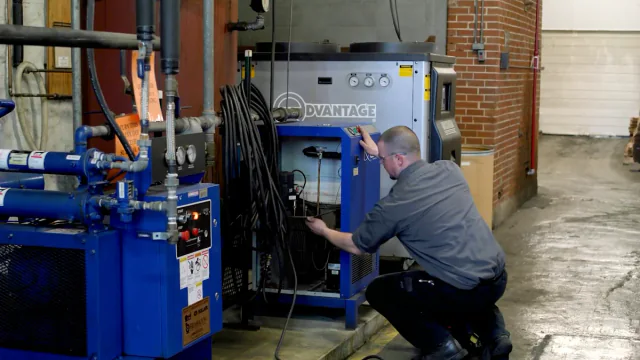
Moisture is the most common cause of compressed air quality problems in industrial facilities - causing rust in distribution piping, corrosion in pneumatic tools and cylinders, product contamination, and instrument failures. Choosing the right air dryer is the most direct way to control moisture in your compressed air system, and the choice between refrigerated and desiccant technology is one that confuses many plant managers and engineers. They are fundamentally different in how they work, what they cost, and what applications they suit. This guide clears up the confusion.
In this article
How Refrigerated Dryers Work
A refrigerated air dryer chills the compressed air to approximately 35 to 38°F (2 to 3°C), causing the water vapor in the air to condense into liquid. The condensed water is collected and drained from the system, and the dried air is reheated slightly before leaving the dryer. The result is compressed air with a pressure dew point of approximately +35 to 38°F - meaning moisture will not condense out of the air as long as downstream temperatures stay above that threshold.
Refrigerated dryers come in two configurations: non-cycling and cycling. Non-cycling dryers run the refrigeration system continuously regardless of compressed air flow, which is simpler and less expensive but wastes energy during low-demand periods. Cycling dryers modulate the refrigeration system to match air throughput, saving energy when demand is low - typically 20 to 40% energy savings over non-cycling units in variable-demand applications.
How Desiccant Dryers Work
Desiccant dryers use adsorption rather than refrigeration to remove moisture. Compressed air passes through a bed of desiccant material - typically silica gel or activated alumina - that adsorbs water vapor from the air. The desiccant is regenerated (dried out) so it can continue to function, using either a purge of dry compressed air (heatless desiccant dryers) or heat (heated desiccant dryers). Two desiccant towers alternate: one drying the air while the other regenerates.
Desiccant dryers achieve much lower dew points than refrigerated dryers - typically -40°F (-40°C) for standard units, with -100°F (-73°C) achievable with specialty designs. This extremely dry air prevents condensation in virtually any application, including outdoor piping in cold climates and applications where even trace moisture causes problems.
The Key Difference: Dew Point
Dew point is the temperature at which moisture begins to condense out of compressed air. It is the defining specification for compressed air dryers:
Refrigerated dryers:
+35°F to +50°F pressure dew point (ISO 8573-1 Class 4 to 6)Desiccant dryers (standard):
-40°F pressure dew point (ISO 8573-1 Class 2)Desiccant dryers (specialty):
-100°F pressure dew point (ISO 8573-1 Class 1)
For most general industrial applications - tools, actuators, general manufacturing - a +35°F dew point from a refrigerated dryer is entirely adequate. Moisture will not condense inside the building, tools will not rust from moisture in the air, and air-operated equipment will function properly.
The +35°F dew point becomes a problem when compressed air is used in freezing outdoor environments (moisture will condense and freeze in outdoor piping), in applications requiring very low moisture content (pharmaceutical, food-grade, certain analytical instruments), or where the distribution system includes significant unheated runs.
Cost and Energy Comparison
Refrigerated dryers are significantly less expensive to purchase and operate than desiccant dryers. A refrigerated dryer sized for a 50 HP compressor typically costs $2,000-$5,000. An equivalent desiccant dryer costs $8,000-$20,000 or more. Operating costs follow the same pattern: refrigerated dryers consume only the energy to run their refrigeration system (typically 3 to 8% of compressor energy for non-cycling units, less for cycling units). Heatless desiccant dryers use 15 to 18% of the dryer's rated airflow as regeneration purge - a significant ongoing energy cost.
The cost premium for desiccant drying is justified when the application requires it. Paying that premium for applications adequately served by refrigerated drying is unnecessary expense.
Which Type Belongs in Which Application
Choose a refrigerated dryer when:
- Your compressed air is used entirely indoors in a heated environment
- Applications include general manufacturing tools, pneumatic actuators, and standard industrial processes
- No food-grade, pharmaceutical, or regulatory air quality requirements exist
- Budget is a primary consideration and the application does not demand ultra-dry air
Choose a desiccant dryer when:
- Compressed air distribution includes outdoor piping or unheated spaces in cold climates (critical in the Midwest, where winter temperatures regularly drop well below the +35°F dew point of a refrigerated dryer)
- Regulated industries require documented ultra-low moisture content (pharmaceutical, food-grade direct contact applications)
- Instrumentation or process equipment requires -40°F or lower dew point
- Instrument air systems where any moisture causes measurement errors
- Pneumatic spray painting where moisture causes finish defects
Hybrid Approaches
Many facilities benefit from a combination: a refrigerated dryer on the main plant air header for general use, with a dedicated desiccant dryer on a sub-header serving specific applications that require ultra-dry air. This avoids the cost and energy penalty of running the entire plant air supply through desiccant drying when only a portion of the demand requires it.
Brabazon can evaluate your specific applications, distribution system layout, and requirements to recommend the right dryer type - or combination - for your facility. We supply and service both refrigerated and desiccant dryers and have no preference toward either; the right recommendation depends entirely on your application.
Related Resources
- Industrial Air Compressors & Dryers - Brabazon supplies refrigerated and desiccant dryers alongside compressor systems
- Service Agreements - keep your dryer running correctly with a preventive maintenance plan
- Air Compressor Storage Tanks - storage tanks work hand-in-hand with dryers for system performance
Get a Dryer Recommendation
Not Sure Which Dryer Type Is Right for You?
Keep going: tools and next steps
- CFM calculator: dryers are sized to system cfm, so confirm the flow number first.
- Air receiver tank calculator: dry storage after the dryer smooths demand spikes; size it here.
- Product catalog by model: compressors and air treatment equipment we stock and service.
- Compressed air audits: a dew point and demand study settles the refrigerated vs desiccant question with data.
Questions on your own system? Call 800.825.3222 and ask for an engineer. We answer 24/7.